
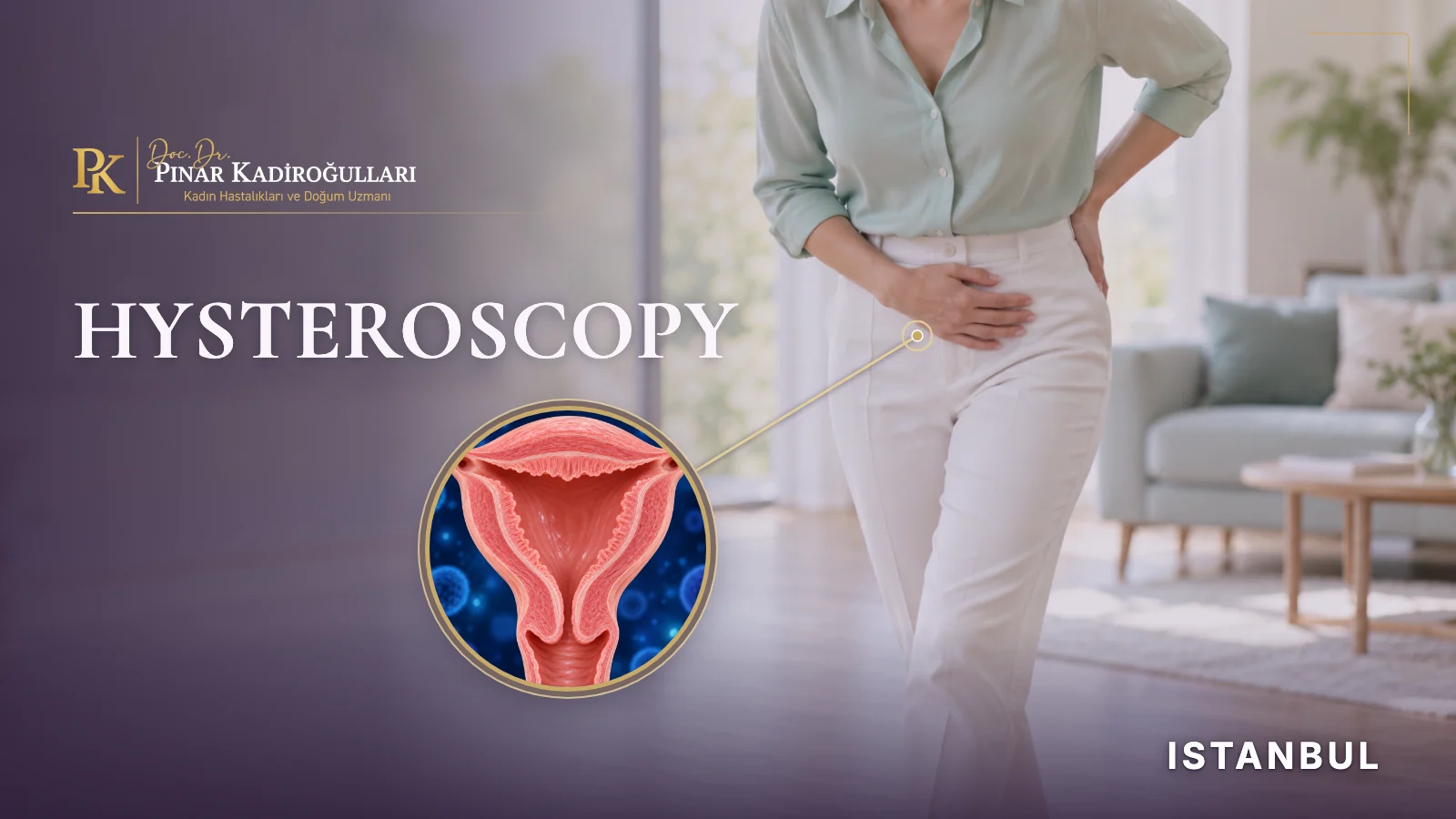

Assoc. Prof. Dr. Pınar Kadiroğulları
Assoc. Prof. Dr. Pınar Kadiroğulları is a specialist in obstetrics and gynecology. She works in the areas of pregnancy monitoring, HPV and cervical health, genital aesthetics, and gynecological surgery.
Her approach is based on current scientific guidelines.
Hysteroscopy is a gynecological method in which the inside of the uterus is examined in detail through the cervix using a thin telescopic camera (hysteroscope). It is used for both diagnostic (abnormal bleeding, infertility evaluation) and therapeutic purposes (removal of polyps and submucosal fibroids). Since it does not require an abdominal incision, it is widely used in intrauterine procedures.
In modern gynecological surgical practice, the hysteroscopic approach is preferred in line with the guidelines of the AAGL and ESGE, taking into account the patient’s clinical condition and the need for diagnosis or treatment. At her practice in Nişantaşı, Istanbul, Assoc. Prof. Dr. Pınar Kadiroğulları performs hysteroscopy in an office setting or under general anesthesia, depending on the case.
Information Note
Hysteroscopy is performed without an abdominal incision. The duration and discharge plan depend on the type of procedure and the individual case. For specific treatments, you can also visit our Myomectomy and Laparoscopic Surgery pages.
What Is Hysteroscopy and How Is It Performed?
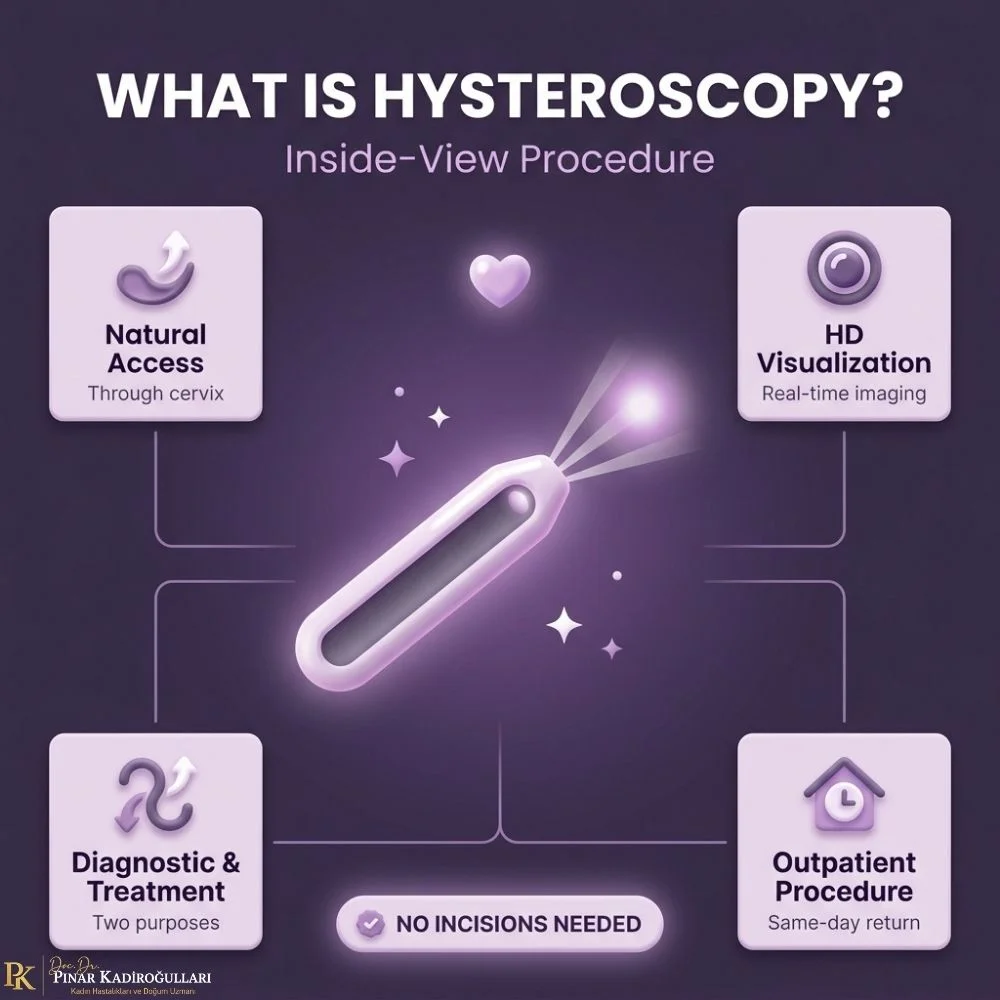
Hysteroscopy is a minimally invasive gynecological method in which the inside of the uterus (uterine cavity) is visualized through a thin and flexible camera inserted through the cervix (cervical canal). Since it does not require any abdominal incision, it is also referred to as “incision-free surgery.”
Two Types of Hysteroscopy
1. Diagnostic Hysteroscopy: A procedure in which the inside of the uterus is only visualized. It can be performed in an office setting without anesthesia in 5-15 minutes, using a thin hysteroscope (3-5 mm).
2. Operative (Therapeutic) Hysteroscopy: A procedure in which abnormalities within the uterus (polyps, fibroids, septum, adhesions) are removed along with visualization. It takes 30-60 minutes under general or spinal anesthesia.
The Surgical Process
- Preparation: The procedure is scheduled within 5-10 days after the menstrual period ends (when the uterine lining is thin).
- Positioning: The patient lies in the standard gynecological examination position.
- Distension: The uterine cavity is filled with saline solution or CO2 gas to create a clear field of view.
- Visualization: The hysteroscope is inserted, and a detailed examination is performed via the monitor.
- Procedure: If necessary, treatment is carried out using specialized instruments.
Important Information
Hysteroscopy is also referred to as “closed surgery” — because no incision is made on the body to access the uterine cavity. Access is achieved through the cervix via the natural pathway.
In Which Cases Is Hysteroscopy Used?
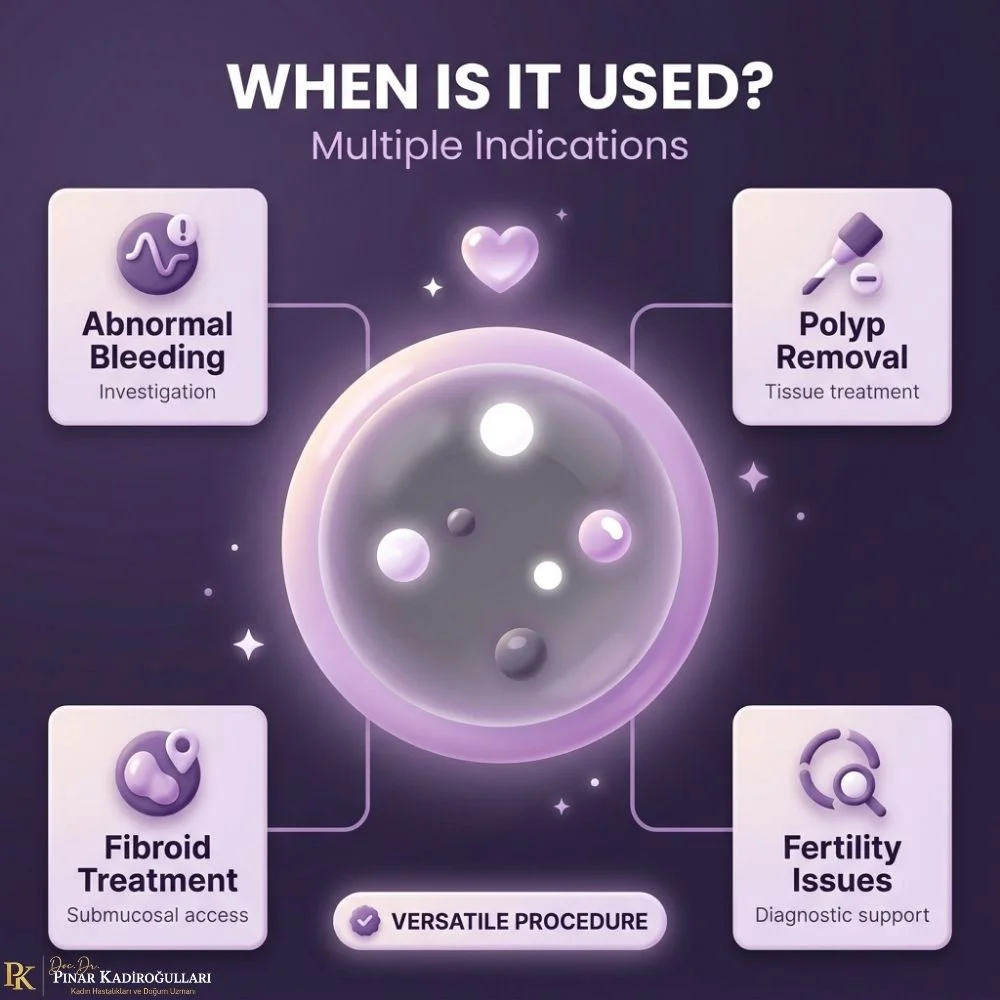
Hysteroscopy is used in gynecology for the diagnosis and treatment of many intrauterine conditions. The indications are grouped into two main categories: diagnostic and therapeutic.
1. Diagnostic Hysteroscopy
- Abnormal uterine bleeding (heavy, prolonged, or intermenstrual bleeding)
- Postmenopausal bleeding
- Infertility evaluation: Structural assessment of the uterine cavity. For details, you can visit our Infertility Treatment page.
- Recurrent pregnancy loss
- Diagnosis of Asherman syndrome (intrauterine adhesions)
- Congenital uterine anomalies (uterine septum, didelphys)
- Evaluation of suspicious intrauterine findings detected on ultrasound
2. Therapeutic Hysteroscopy
- Removal of endometrial polyps (polypectomy)
- Removal of submucosal fibroids. For details, you can visit our Myomectomy page.
- Release of intrauterine adhesions (adhesiolysis)
- Resection of a uterine septum (septum resection)
- Removal of retained intrauterine tissue (after miscarriage)
- Endometrial ablation (treatment of heavy bleeding)
- Removal of intrauterine foreign bodies (embedded IUD)
3. Pre-IVF Evaluation: Assessment of the uterine cavity and, when necessary, the removal of polyps or fibroids may be considered; this is decided by the physician.
Diagnosis
Intrauterine conditions that cannot be clearly identified with ultrasound can be evaluated through direct visualization with hysteroscopy and, when necessary, treated in the same session.
Features of Hysteroscopy
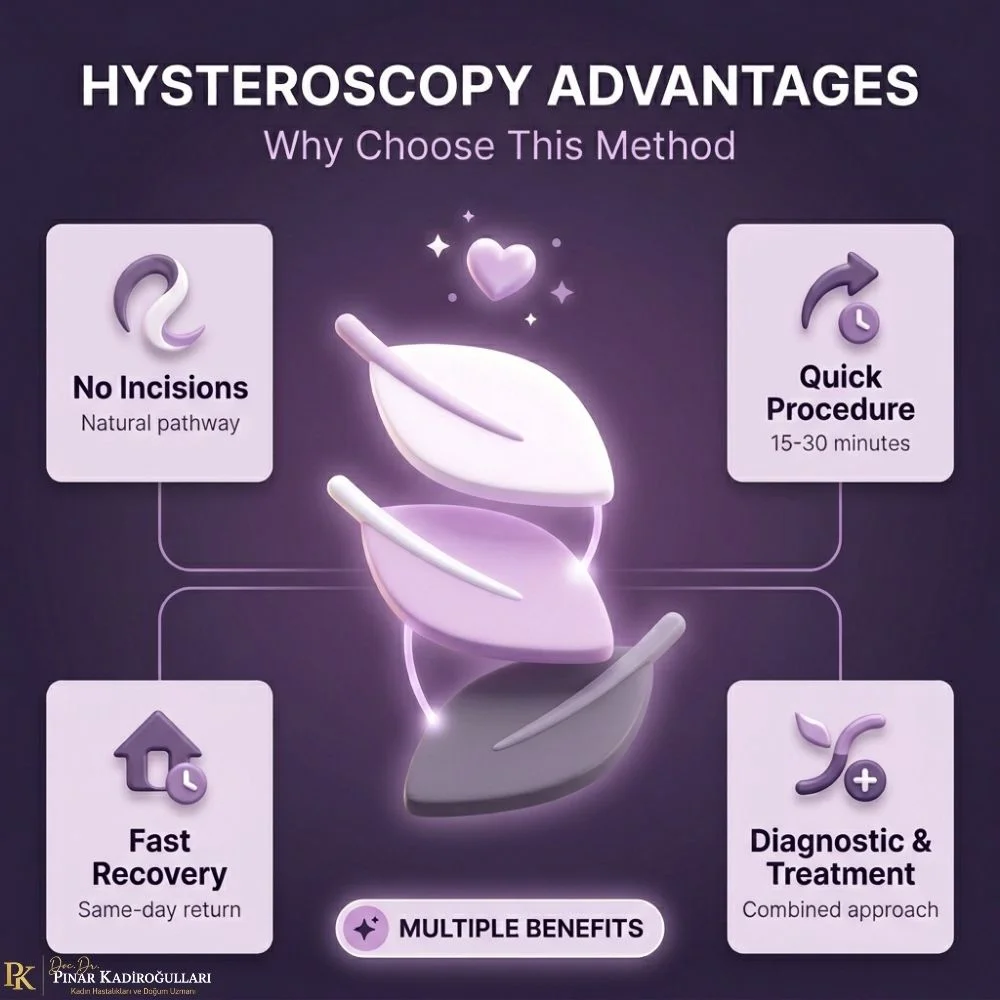
Hysteroscopy is performed through the natural pathway, without an incision on the body. Recovery time and risks vary according to the type of procedure and the individual case.
1. Incision-Free Surgery
Leaves No Marks on the Body
Since access is gained through the natural pathway, no incision is made on the abdomen or vagina.
- No Incisions: No surgical incisions are made on the abdomen or vagina.
- No abdominal incision is made, so there is no abdominal surgical scar.
2. Recovery
Discharge and Return to Daily Life
Discharge and return to daily life vary according to the type of procedure and the individual case.
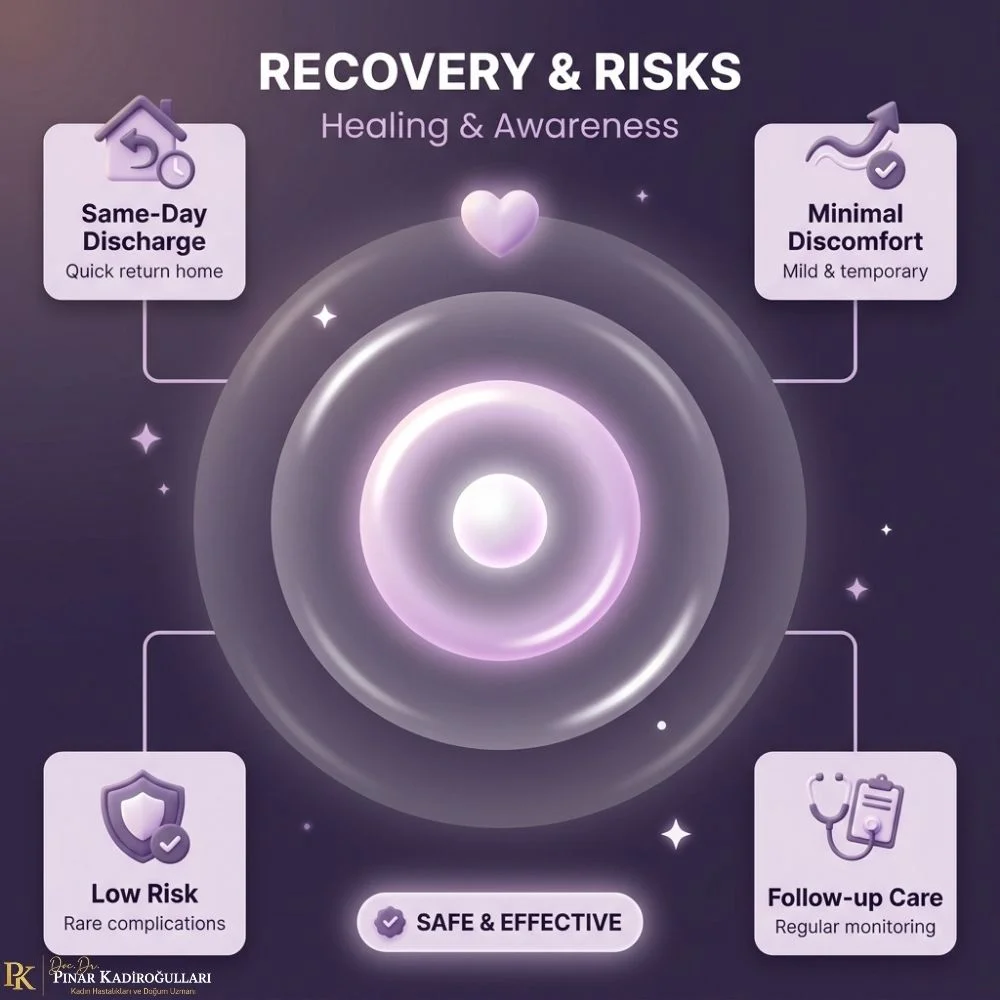
- Same-Day Discharge: Patients can return home after 2-4 hours of post-procedure rest.
- Pain: Mild pain may occur and can be managed with painkillers prescribed by your physician.
- Return to Work: Office work can typically be resumed within 2-3 days.
3. Diagnosis and Treatment in a Single Session
Diagnosis and Treatment in a Single Session
Hysteroscopy allows diagnosis and treatment in a single session.
- Treatment Under Direct Vision: Abnormalities are removed under direct visual guidance.
- Tissue Sampling: Biopsies can be taken from suspicious areas.
Recovery and General Risks After Hysteroscopy
The recovery process after hysteroscopy varies from person to person. Patients are typically discharged on the same day.
Typical Recovery Timeline
- First 2-4 hours: Hospital observation and fluid intake.
- Same day: Discharge and rest at home.
- Next day: Return to normal activities.
- 2-3 days: Return to work and office tasks.
- 1 week: Sexual intercourse may be resumed after the doctor’s approval.
Temporary Symptoms That May Occur
- Mild vaginal bleeding: May last 3-7 days, considered normal.
- Mild cramping pain (1-2 days)
- Nausea (anesthesia-related, short-lived)
- Shoulder pain: 1-2 days if CO2 was used
Possible General Risks
- Uterine perforation — rare
- Anesthesia-related complications (in operative hysteroscopy)
- Fluid overload syndrome — in long procedures
- Infection — rare
- Cervical injury (damage to the cervix — rare)
⚠️ When to Consult a Physician
- Fever above 38°C or chills
- Excessive or clotted vaginal bleeding
- Severe and persistent abdominal pain
- Foul-smelling vaginal discharge (a sign of infection)
- Fainting, dizziness, or general weakness
Important Reminder
Hysteroscopy carries the risks of any procedure, and results vary from person to person. Your physician will inform you about the risks before the procedure.
Results may vary from person to person in any surgical or interventional procedure. It is recommended that you obtain detailed advice from your physician before the procedure.
Frequently Asked Questions
Is hysteroscopy painful?
Diagnostic hysteroscopy can be performed in an office setting without anesthesia; a mild cramping sensation may be felt. Operative hysteroscopy (for the removal of polyps or fibroids) is performed under general or spinal anesthesia, so pain is not felt during the procedure. Mild cramping pain that lasts for 1-2 days afterward can be controlled with painkillers.
When should hysteroscopy be performed?
Hysteroscopy is usually planned in the days after the menstrual period ends, when the uterine lining (endometrium) is thin and the uterine cavity can be visualized more clearly. It is not performed during menstruation or pregnancy. Apart from emergencies (heavy bleeding or suspicious findings), the appointment is scheduled according to the menstrual cycle.
How long should I wait to try for pregnancy after hysteroscopy?
The waiting period to try for pregnancy after hysteroscopy depends on the type of procedure performed. After diagnostic hysteroscopy, pregnancy can be attempted 1 month later. After the removal of polyps or small submucosal fibroids, a wait of 2-3 months is recommended, while after the treatment of Asherman syndrome or a uterine septum, 3-6 months is advised. Your doctor will determine a personalized waiting period based on the details of your procedure.
Does hysteroscopy require anesthesia?
Anesthesia requirements vary depending on the type of hysteroscopy. Diagnostic hysteroscopy can be performed in an office setting without anesthesia or with mild sedation. Operative hysteroscopy (such as the removal of polyps or fibroids, or the treatment of a uterine septum) is performed under general or spinal anesthesia. The choice of anesthesia is determined based on the duration of the procedure, the patient’s clinical condition, and personal preference.
When can I resume sexual intercourse after hysteroscopy?
Sexual intercourse should be avoided for at least 1 week after hysteroscopy. This period is necessary for the healing of the uterine lining and to minimize the risk of infection. After operative hysteroscopy (such as the removal of polyps or fibroids), this period may extend up to 2-3 weeks. Sexual intercourse should be avoided as long as vaginal bleeding continues. The exact waiting period should be determined under your doctor’s supervision.
Our Treatments
References
The medical content on this page has been prepared based on the current clinical guidelines and scientific publications of international and national authoritative organizations. Below, you can review the main PDF references used for hysteroscopy practice and the academic publications of Assoc. Prof. Dr. Pınar Kadiroğulları.
The Use of Hysteroscopy for the Diagnosis and Treatment of Intrauterine Pathology: ACOG/AAGL Joint Committee Opinion No. 800
Authors: American College of Obstetricians and Gynecologists (ACOG) & American Association of Gynecologic Laparoscopists (AAGL) | Publication: Obstet Gynecol 2020 | Source Type: International Clinical Committee Opinion
Office Hysteroscopy: RCOG Green-top Guideline No. 59
Authors: Royal College of Obstetricians and Gynaecologists (RCOG) & British Society for Gynaecological Endoscopy (BSGE) | Publication: BJOG 2024 | Source Type: Green-top Clinical Guideline
AAGL Practice Report: Management of Hysteroscopic Distending Media
Author: American Association of Gynecologic Laparoscopists (AAGL) | Publication: J Minim Invasive Gynecol 2013 | Source Type: International Clinical Practice Guideline (PubMed)
AAGL/ESGE Joint Guideline: Hysteroscopic Management of Intrauterine Adhesions (Asherman Syndrome)
Authors: American Association of Gynecologic Laparoscopists (AAGL) & European Society of Gynaecological Endoscopy (ESGE) | Publication: J Minim Invasive Gynecol 2017 | Source Type: Joint Clinical Guideline by Two Organizations (PubMed PMC, Full Text)
BSGE/ESGE Guideline on Fluid Distension Management in Operative Hysteroscopy
Authors: British Society for Gynaecological Endoscopy (BSGE) & European Society for Gynaecological Endoscopy (ESGE) | Publication: Gynecological Surgery 2016 | Source Type: Joint Guideline by Two European Organizations (PubMed PMC, Full Text)
International Consensus Terminology for Hysteroscopic Procedures
Authors: Carugno J, Grimbizis G, Franchini M, et al. | Publication: J Minim Invasive Gynecol 2022;29(3):385-91 | Source Type: International Consensus Document
Clinical Practice in Office Hysteroscopy: Patient Evaluation and Management of Complications
Publication: Obstetrics & Gynecology Science 2024 | Source Type: Peer-Reviewed Clinical Review (PubMed PMC, Full Text)
⭐ Academic Publications by Assoc. Prof. Dr. Pınar Kadiroğulları on Uterine Surgery
Publications authored by the doctor in the fields of uterine surgery, gynecological procedures, and sexual/anatomical integrity
Abdominal Hysterectomy with a Uterine Manipulator: A Randomized Controlled Clinical Trial
Authors: Kıyak H, Karacan T, Özyürek ES, Türkgeldi LS, Kadiroğulları P, Seçkin KD | Publication: Journal of Investigative Surgery 2021;34(10):1052-1058 | Source Type: Randomized Controlled Clinical Trial (PubMed)
📍
Modified Extraperitoneal Uterosacral Ligament Suspension: A 4-Clamp Technique After Vaginal Hysterectomy
Authors: Kadiroğulları P, Seçkin KD | Publication: Journal of Investigative Surgery 2019 | Source Type: Peer-Reviewed Clinical Research (PubMed)
The Relationship Between HbA1c Levels and Ovarian Reserve: A Clinical Study in Type 1 Diabetes Patients
Authors: Kadiroğulları P, Demir E, Bahat PY, Kıyak H, Seçkin KD | Publication: Gynecological Endocrinology 2020;36(5):426-430 | Source Type: Peer-Reviewed Scientific Article (PubMed)
Important Note
The information on this page is intended for general informational purposes and does not replace individual medical advice. For personal questions, diagnosis, or treatment planning related to hysteroscopy, you should always consult your specialist gynecologist. The content of this page has been prepared by Assoc. Prof. Dr. Pınar Kadiroğulları in light of clinical experience and current scientific literature.
“Obstetrics and Gynecology”