

Assoc. Prof. Dr. Pınar Kadiroğulları
Assoc. Prof. Dr. Pınar Kadiroğulları is a specialist in obstetrics and gynecology. She works in the areas of pregnancy monitoring, HPV and cervical health, genital aesthetics, and gynecological surgery.
Her approach is based on current scientific guidelines.
Genital darkening treatment addresses hyperpigmentation that occurs in the female genital area, particularly in the groin, vulva, inner labia, and anal region. Some women are affected by this condition; treatment is optional and is planned individually.
In modern gynecological aesthetic practice, a personalized laser treatment is planned in line with the guidelines of the ISAPS and dermatology guidelines, taking into account skin type, the degree of darkening, and patient expectations. At her practice in Nişantaşı, Istanbul, Assoc. Prof. Dr. Pınar Kadiroğulları evaluates the condition by examination and plans the treatment individually when it is appropriate.
Information Note
Genital area darkening is a physiological condition. It is associated with hormonal changes and friction, and does not pose a health risk. However, treatment may be preferred due to aesthetic concerns and psychological discomfort. The treatment is non-surgical and is applied in sessions.
What Is Genital Area Darkening and Why Does It Occur?
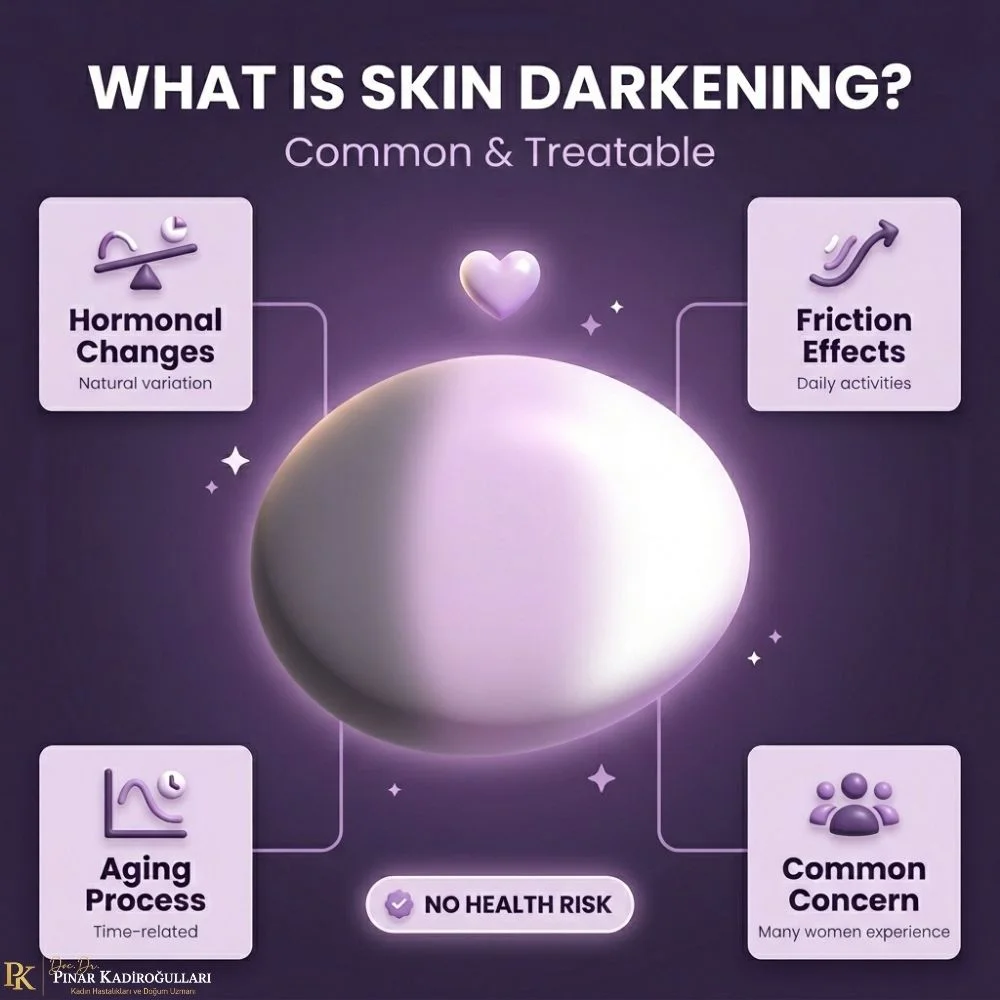
Genital area darkening (hyperpigmentation) is a darkening condition that occurs as a result of the excessive accumulation of melanin pigment in the female genital area. Also known as “vulvar pigmentation” in the medical literature, this condition arises from a combination of hormonal, mechanical, and genetic factors. Although it is mostly a harmless condition, it may cause aesthetic concerns.
Causes of Genital Darkening
- Hormonal changes: Pregnancy, oral contraceptives, and menopause
- Increased estrogen and progesterone (puberty, pregnancy)
- Continuous friction: Tight clothing and tight underwear
- Excessive weight and obesity (skin folds)
- Mechanical trauma: Shaving, waxing, and laser hair removal
- Genetic predisposition and ethnic characteristics
- Age-related pigment accumulation
- Chronic vaginal infections
- Certain medications: Anticonvulsants, antibiotics
Affected Areas
- Inguinal area (groin): The most commonly affected area
- Vulva (external genitalia) and inner labia
- Perianal area
- Mons pubis (the mound of Venus)
- Perineal area (between the vagina and anus)
- Sometimes the upper inner thigh
Is It Medically Dangerous?
Genital darkening is most often a harmless physiological condition. However, sudden, very dark, and irregular color changes warrant a gynecological examination. This may, in rare cases, be a sign of vulvar melanosis or malignant skin changes.
Important Information
The treatment of genital darkening is performed entirely for aesthetic purposes. Since it does not pose a health risk, treatment is elective. Before treatment, a gynecological examination is performed to rule out any potentially malignant changes. Then, an appropriate laser plan is determined.
In Which Cases Is Genital Darkening Treatment Necessary?
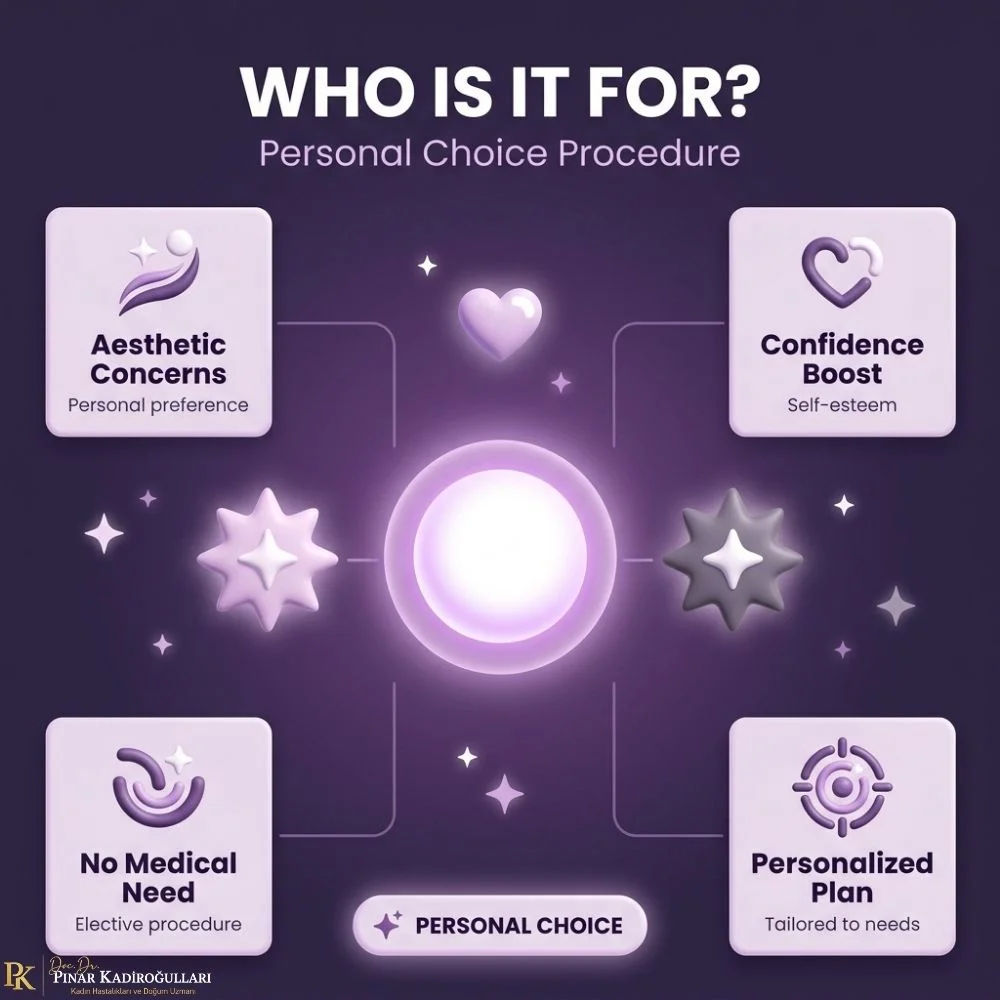
Genital darkening treatment is planned according to the patient’s clinical complaints and aesthetic expectations. Not every case of darkening requires treatment; however, when it causes psychological discomfort and aesthetic concerns, laser treatment is recommended. Treatment should be considered in the following situations.
1. Aesthetic Concerns
- Marked color darkening and sensitivity with one’s partner
- Asymmetric and irregular pigmentation
- Visible darkening when wearing bikinis or swimsuits
- Increased darkening after childbirth
- Sharp color contrast at the junction between the inner labia and the groin
- Loss of genital self-confidence
2. Psychological Effects
- Loss of sexual self-confidence and avoidance of intimacy with the partner
- Avoidance of sexual intercourse
- Discomfort when seen in the mirror
- Privacy concerns (difficulty during gynecological examinations)
- Body image issues
3. Accompanying Issues
- Darkening accompanied by friction-related irritation
- Postpartum darkening due to hormonal changes
- Pigmentation changes during menopause. For details, you can visit our Menopause Treatment page.
- Pigmentation occurring after laser hair removal
- Pigmentation following chronic dermatitis or eczema
4. Other Concurrent Procedures
- Color matching after labiaplasty. For details, you can visit our Labiaplasty page.
- Holistic aesthetics after vaginoplasty
- Combined with genital hair removal
Diagnosis and Evaluation
A detailed gynecological examination is performed before treatment. The skin type (Fitzpatrick), the degree of darkening, and any accompanying pathologies are evaluated. Special care is required during application in cases of pregnancy, active infection, or very dark skin types (Fitzpatrick V-VI).
Laser Treatment Methods for Genital Darkening
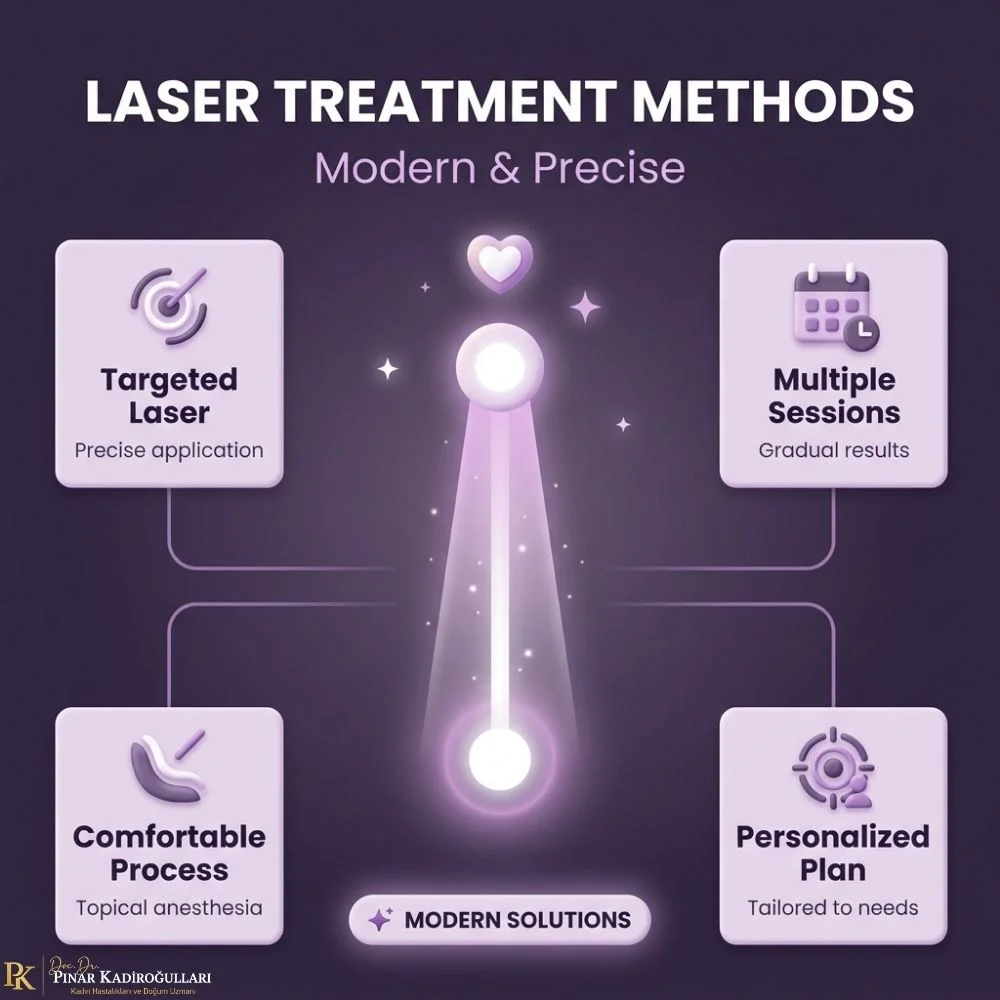
The laser methods used in genital darkening treatment are selected based on the patient’s skin type, degree of pigmentation, and sensitivity. Laser-based approaches such as Q-Switched or Pico lasers may be considered; the choice is made individually.
Method 1 – Classical
Q-Switched Laser (ND:YAG)
A classical laser method that gradually reduces melanin by fragmenting pigmented tissue with nanosecond pulses.
- Indications: Mild-to-moderate darkening and large surface areas.
- Duration: 20-30 minutes, with a topical anesthetic cream.
- Sessions: 4-6 sessions, with 3-4 week intervals.
- Suitable for treating large areas.
- Limitations: Requires careful use in very dark skin types.
Method 2
Pico Laser (Picosecond)
A laser type that fragments pigmented tissue into micro-particles using picosecond pulses.
- Indications: Moderate-to-severe darkening and resistant pigmentation.
- Duration: 15-25 minutes, with a topical anesthetic cream.
- Sessions: 3-5 sessions, with 4-6 week intervals.
- Fewer sessions may be needed in some cases.
- Limitations: Specialized equipment is required.
Post-Treatment Sessions and Aftercare
The number of sessions varies from person to person. Each session is performed with same-day discharge. Post-session aftercare is important for healthy healing.
Number of Sessions and Intervals
- Q-Switched Laser: 4-6 sessions, with 3-4 week intervals
- Pico Laser: 3-5 sessions, with 4-6 week intervals
- The first results are visible from the 2nd-3rd session onwards
- Final results become apparent 2-3 months after the completion of treatment
Post-Session Aftercare
- First 24-48 hours: Mild redness and tenderness are normal
- Keep the area clean and dry
- Use the moisturizing/soothing cream recommended by your doctor
- First week: Hot showers, saunas, swimming pools, and the sea are PROHIBITED
- Avoid wearing tight underwear
- Sexual intercourse: Can be resumed after 48-72 hours
- Sun protection: Avoid direct sunlight for 2-3 weeks
- Use the doctor-recommended SPF 50+ protective cream
Duration of Effect
- Initial effect: Visible from the 2nd-3rd session onwards
- Final results: Apparent 2-3 months after the completion of treatment
- Duration: Between 1-2 years, with individual variation
- An annual maintenance session is recommended
- Hormonal changes (pregnancy, menopause) may cause repigmentation
⚠️ When to Consult a Physician
- Severe and persistent pain or burning
- Excessive redness, swelling, or blister formation
- Excessive darkening (post-inflammatory hyperpigmentation)
- White spots (hypopigmentation)
- Burning sensation when urinating, discharge, or foul odor
- Signs of infection (fever, pain)
Important Reminder
Genital darkening treatment is a non-surgical aesthetic application. Results vary from person to person and depend on skin type and aftercare.

Frequently Asked Questions
Is genital darkening laser treatment painful?
Before the procedure, a topical anesthetic cream is applied and given 30-45 minutes to take effect. A mild stinging or warm sensation may be felt during the application. Some patients may experience mild tenderness or a burning sensation for 1-2 days; this is normal and is relieved with the doctor-recommended cream.
After How Many Sessions Are the Effects Visible?
Initial effects generally begin to appear from the 2nd-3rd session onwards. Final results become apparent 2-3 months after the completion of treatment, as the skin’s regeneration process needs to be complete. The number of sessions varies depending on the method: 4-6 sessions for the Q-Switched laser and 3-5 sessions for the Pico laser. Each session is performed at 3-4 week intervals. The degree of darkening and skin type may influence this timeline.
Will scars or burns remain after laser treatment?
Scarring and burns are uncommon when treatment is performed with parameters suited to the skin type. However, without a proper skin type assessment or with inadequate parameters, post-inflammatory hyperpigmentation (a temporary, darker spot) may occur. For this reason, a proper skin type assessment before treatment is important.
Can genital darkening treatment be performed on all skin types?
Treatment is possible on nearly all skin types, but different levels of caution are required. Lighter skin types (Fitzpatrick I-III) respond more easily and rapidly. For darker skin types (Fitzpatrick IV-VI), the Pico laser or lower energy parameters are preferred. Treatment is not recommended for those who are pregnant, have an active infection, or have used isotretinoin within the last 6 months. Before the treatment, the skin type is evaluated and a personalized plan is developed.
Are the treatment results permanent?
The duration of the effect varies from person to person. However, repigmentation may occur due to hormonal changes (pregnancy, menopause, oral contraceptives), weight changes, friction, and sun exposure, which can lead to renewed pigmentation. To maintain the results, an annual maintenance session is recommended. Additionally, protective measures (avoiding tight clothing, proper hygiene, and sun protection) help prolong the treatment’s effect.
Our Treatments




References
The medical content on this page has been prepared based on the current clinical guidelines and scientific publications of international and national authoritative organizations. Below, you can review the main PDF references used and the academic publications of Assoc. Prof. Dr. Pınar Kadiroğulları.
ICS/ISSVD Best Practice Consensus: Guideline on Clinical Vulvar and Vaginal Laser Applications
Authors: Preti M, Vieira-Baptista P, Digesu GA, et al. (ICS/ISSVD Joint Working Group) | Publication: Neurourol Urodyn 2019 | Source Type: International Consensus Document
Melasma — Patient Information Brochure
Author: Turkish Society of Dermatology (TDD) | Source Type: National Clinical Information Document (PDF)
Elective Female Genital Cosmetic Surgery — Committee Opinion No. 795
Author: American College of Obstetricians and Gynecologists (ACOG) | Publication: Obstet Gynecol 2020 | Source Type: Committee Opinion / Standards in Aesthetic Gynecology
Lasers for Treatment of Melasma and Post-Inflammatory Hyperpigmentation
Authors: Arora P, Sarkar R, Garg VK, Arya L | Publication: Journal of Cutaneous and Aesthetic Surgery, 2012 | Source Type: Peer-Reviewed Scientific Review (PubMed PMC)
Treatment of Hyperpigmentation and New Approaches
Publication: Türkiye Klinikleri Journal of Dermatology | Source Type: Turkish Peer-Reviewed Medical Journal Article
Use of the Q-switched Nd:YAG Laser for the Treatment of Pigmentary Disorders
Authors: El-Domyati M, Attia S, Saleh F, et al. | Publication: Journal of Cosmetic and Laser Therapy 2010 | Source Type: Clinical Research (PubMed)
Disorders of Hyperpigmentation: Review of Management and Treatment Options
Authors: Wang RF, Ko D, Friedman BJ, Lim HW, Mohammad TF | Publication: Journal of the American Academy of Dermatology (JAAD) 2022 | Source Type: AAD Peer-Reviewed Review
📚 Selected Academic Publications by Assoc. Prof. Dr. Pınar Kadiroğulları
Modified Extraperitoneal Uterosacral Ligament Suspension in Preventing Cuff Prolapse Risk after Vaginal Hysterectomy: 4 Clamp Method
Authors: Kadiroğulları P, Seçkin KD | Publication: Journal of Investigative Surgery 2019 | Source Type: Peer-Reviewed Clinical Research (PubMed)
Evaluation of Relationship Between HbA1c Levels and Ovarian Reserve in Patients with Type 1 Diabetes Mellitus
Authors: Kadiroğulları P, Demir E, Bahat PY, Kıyak H, Seçkin KD | Publication: Gynecological Endocrinology 2020;36(5):426-430 | Source Type: Peer-Reviewed Scientific Article (PubMed)
Abdominal Hysterectomy with a Uterine Manipulator Minimizes Vaginal Shortening: A Randomized Controlled Trial
Authors: Kıyak H, Karacan T, Özyürek ES, Türkgeldi LS, Kadiroğulları P, Seçkin KD | Publication: Journal of Investigative Surgery 2021;34(10):1052-1058 | Source Type: Randomized Controlled Clinical Trial (PubMed)
Important Note
The information on this page is intended for general informational purposes and does not replace individual medical advice. For personal questions regarding genital area darkening and laser treatment, you should always consult your specialist gynecologist. The content of this page has been prepared by Assoc. Prof. Dr. Pınar Kadiroğulları in light of clinical experience and current scientific literature.
“Obstetrics and Gynecology”