

Assoc. Prof. Dr. Pınar Kadiroğulları
Assoc. Prof. Dr. Pınar Kadiroğulları is a specialist in obstetrics and gynecology. She works in the areas of pregnancy monitoring, HPV and cervical health, genital aesthetics, and gynecological surgery.
Her approach is based on current scientific guidelines.
Labiaplasty (labia minora aesthetics) is a genital aesthetic surgery performed to reduce or reshape the inner labia (labia minora) in the female genital area. It may be considered for both functional and aesthetic concerns.
In modern gynecological aesthetic surgical practice, a personalized surgical plan is developed in line with the guidelines of the ISSWSH and ISAPS, taking into account the anatomy of the labia minora, asymmetry, the patient’s expectations, and her lifestyle. At her practice in Nişantaşı, Istanbul, Assoc. Prof. Dr. Pınar Kadiroğulları plans the surgical approach according to the anatomy of the labia minora, asymmetry, and the patient’s expectations.
Information Note
Labiaplasty is a surgical procedure and carries the risks of any surgery. The duration and discharge plan depend on the technique and the individual case. Whether it is combined with vaginoplasty is decided after examination.
What Is Labiaplasty and Why Is It Performed?
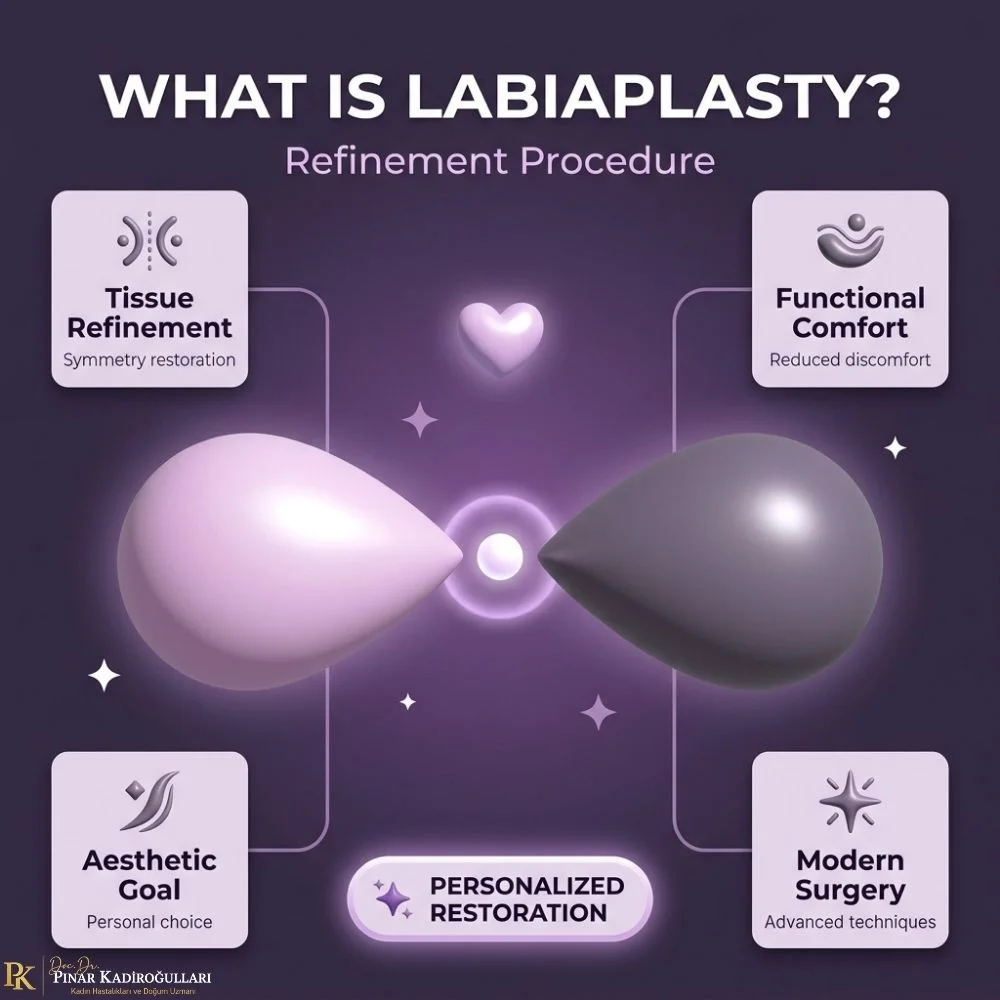
Labiaplasty (labia minora aesthetics) is a surgical procedure performed to reduce, reshape, or restore symmetry to the inner labia, known as the labia minora, in the female genital area. Also referred to as “labia minora reduction” in the medical literature, this procedure is one of the methods used in female genital aesthetic surgery.
The normal size of the labia minora can vary from person to person. However, labiaplasty may be planned when the inner labia extend beyond the outer labia, appear asymmetrical, or cause functional discomfort. During the procedure, excess tissue is removed using specialized surgical techniques, and the remaining tissue is reshaped in a way that preserves a natural appearance.
Causes of Inner Labia Enlargement/Sagging
- Genetic predisposition: Inherited anatomical features
- Hormonal changes (puberty, pregnancy, menopause)
- Birth trauma and the resulting changes in the tissues
- Age-related loss of elasticity
- Significant weight loss or gain
- Chronic irritation and mechanical trauma
- Asymmetric development (left-right differences)
- Certain sports (cycling, horseback riding) and continuous friction
Labiaplasty may be considered for functional and aesthetic reasons. It is chosen not only for aesthetic concerns but also due to physical discomfort, hygiene issues, difficulty during sexual intercourse, and the psychological loss of self-confidence.
Important Information
There is no “ideal” size for the labia minora. Every woman’s anatomy is unique. The decision for labiaplasty is made through a combined assessment of the patient’s symptoms, functional concerns, and psychological well-being. Aesthetic concerns alone are not sufficient; there should be a specific complaint or concern driving the decision.
In Which Cases Is Labiaplasty Performed?
The decision for labiaplasty is made based on the patient’s clinical complaints and expectations. The procedure addresses both functional problems and aesthetic concerns. Labiaplasty is recommended in the following situations.
1. Physical Discomfort
- Friction and irritation of the inner labia against underwear
- Discomfort and pain when wearing tight pants, leggings, or swimsuits
- Friction during sports (especially cycling, running, and horseback riding)
- Chronic vaginal irritation and infections
- Mechanical trauma and edema
- Hygiene difficulties and an increased risk of urinary tract infections
2. Sexual Health Issues
- Pain (dyspareunia) during sexual intercourse
- The inner labia being pushed inward during intercourse
- Loss of sexual self-confidence and performance anxiety
- Avoidance of intimacy with the partner
- Avoidance of sexual intercourse
3. Aesthetic Concerns
- The inner labia visibly extending beyond the outer labia
- Marked asymmetry between the right and left sides
- Darkening of the inner labia (hyperpigmentation)
- Anatomical changes after childbirth
- Discomfort when wearing bikinis or swimsuits
- Loss of genital self-confidence
4. Other Concurrent Procedures
- Combined with vaginoplasty. For details, you can visit our Vaginoplasty page.
- Combined with hoodoplasty (clitoral aesthetics)
- Combination with mons pubis aesthetics
- Comprehensive postpartum genital reconstruction
Diagnosis and Evaluation
The decision for labiaplasty is made through a detailed examination. The size of the inner labia, the degree of asymmetry, tissue quality, and any accompanying pathologies are evaluated. The procedure is not performed on patients under 18 years of age, and those with active vaginal infections are scheduled after treatment. The timing of the operation is planned by the physician.

Labiaplasty Methods
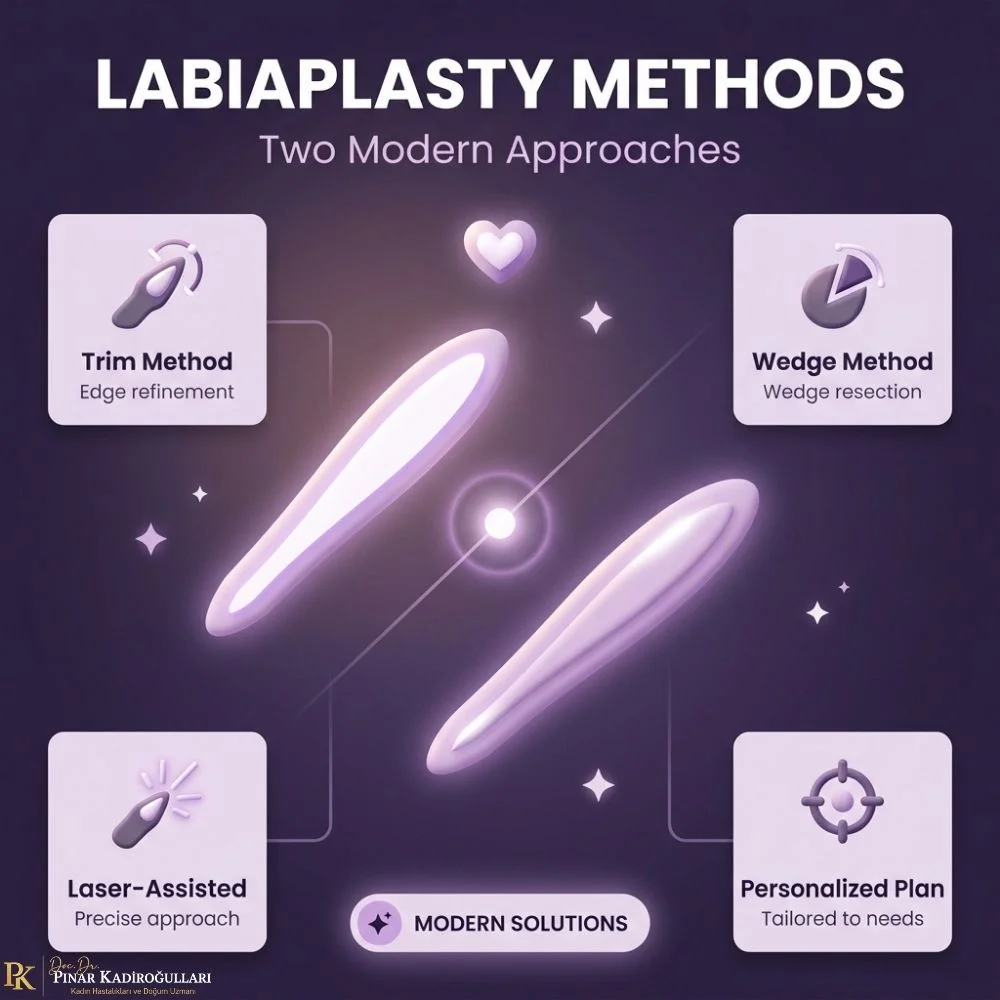
The method of labiaplasty is determined by considering the patient’s labia minora structure, tissue quality, and personal expectations. Trim (edge) and wedge (V) techniques are described; the choice is made individually.
Method 1
Trim (Edge) Technique
The classical labiaplasty method in which excess tissue is excised from the outer edge of the inner labia.
- Indications: Darkening of the outer edge and asymmetric enlargement.
- Duration: 30-60 minutes, performed under local anesthesia or sedation.
- Discharge: Same day, with 3-5 days of rest.
- Features: A straightforward technique.
- Limitations: Loss of the natural border and possible visible suture lines.
Method 2
Wedge (V) Technique
A method in which a V-shaped wedge of tissue is removed from the central portion of the inner labia and the edges are reapproximated.
- Indications: Cases where preservation of the natural border is desired.
- Duration: 45-90 minutes, performed under sedation or general anesthesia.
- Discharge: Same day, with 5-7 days of rest.
- Features: The natural edge is preserved.
- Limitations: Requires a more delicate technique.
Recovery and Results After Labiaplasty
The recovery process after labiaplasty varies from person to person. Patients are typically discharged on the same day. Careful aftercare during the first 4-6 weeks supports healing.
Typical Recovery Timeline
- First 24-48 hours: Mild swelling and pain, manageable with painkillers.
- 3-5 days: Swelling subsides; light activity is possible.
- 1 week: Return to office work and a follow-up examination.
- 2-3 weeks: Light sports activities can be resumed.
- 4-6 weeks: Full recovery; doctor’s approval for sexual intercourse.
Postoperative Care
- First week: Tight clothing, tampons, and tight pants are prohibited
- Since dissolvable sutures are used, suture removal is not required
- Bathing: Standing showers are allowed; bathtubs, swimming pools, and the sea are prohibited for 4-6 weeks
- Antiseptic care: A cleansing solution recommended by the doctor
- Loose, cotton underwear that is not tight
- Strenuous sports: After 6 weeks, with the doctor’s approval
Results
- Final results: Become apparent within 2-3 months (when swelling completely subsides)
- Changes after childbirth may occur, which should be considered when planning
⚠️ When to Consult a Physician
- Fever above 38°C or chills
- Severe and persistent pain
- Excessive or clotted bleeding
- Wound dehiscence, discharge, or foul odor at the suture site
- Excessive swelling or increasing bruising
- Burning sensation when urinating or inability to urinate
Important Reminder
Labiaplasty is a surgical procedure; results and effects on sexual function vary from person to person. You can consult your doctor about combining the procedure with vaginoplasty, hoodoplasty, or mons pubis aesthetics.

Frequently Asked Questions
Are the results of labiaplasty permanent?
The removed labia minora tissue does not grow back. However, changes in the labia may occur during pregnancy, childbirth, significant weight changes, or natural aging. Results vary from person to person.
Does sexual pleasure decrease after labiaplasty?
Excess tissue is removed during the procedure, and the nerves and clitoris are intended to be preserved. As with any surgery, there is a risk of changes in sensation; the possible effects on sexual function are discussed with your physician before the procedure.
At what age can labiaplasty be performed?
It is not performed on patients under 18 years of age, as their development is not yet complete. There is no upper age limit; the procedure can also be performed on postmenopausal women if their general health is suitable. The decision is based not on age but on the patient’s clinical complaints and psychological readiness. Suitability for the procedure is determined through a detailed examination.
Will scars remain after labiaplasty?
Dissolvable sutures are used, and incision marks usually fade over time; scar appearance varies from person to person. Following your doctor’s aftercare recommendations supports healing.
Our Treatments




References
The medical content on this page has been prepared based on the current clinical guidelines and scientific publications of national and international authoritative organizations. The references include multicenter clinical research from Türkiye, as well as the academic publications of Assoc. Prof. Dr. Pınar Kadiroğulları.
Outcomes and Complications of Labiaplasty in Turkish Women: A Multicenter Study
Study: 2,594 patients, specialists from 43 different centers | Publication: International Urogynecology Journal 2024 | Source Type: Multicenter Clinical Study (PubMed)
The Impact of Technique Selection in Labiaplasty Surgery: A Comparison of Trim and Wedge Resection
Authors: Uçar E, Bestel M, Uçar BH, Doğan O (Turkish academics — Istanbul Esenyurt, Cemil Taşcıoğlu, Nişantaşı University) | Publication: Journal of Clinical Medicine 2025 | Source Type: Turkish Peer-Reviewed Clinical Study (PubMed PMC, Full Text)
Elective Female Genital Cosmetic Surgery — Committee Opinion No. 795
Author: American College of Obstetricians and Gynecologists (ACOG) | Publication: Obstet Gynecol 2020 | Source Type: Committee Opinion / Standards for Female Genital Aesthetic Surgery
A Comprehensive Assessment of Labiaplasty Techniques: A Systematic Review and Meta-Analysis
Publication: Aesthetic Surgery Journal (Oxford Academic) 2024 | Source Type: Systematic Review of 86 Studies
An Algorithm for Trim and Wedge Labiaplasty: Patient-Based Technique Selection
Publication: Aesthetic Surgery Journal 2023 | Source Type: Peer-Reviewed Clinical Decision Algorithm (PubMed)
Labia Minora Reduction Techniques: A Comprehensive Literature Review of 1,981 Patients
Publication: Aesthetic Surgery Journal 2015 | Study: Analysis of 8 different techniques across 38 studies | Source Type: Peer-Reviewed Systematic Review (PubMed)
Optimizing the Safety and Outcomes of Labiaplasty: A Systematic Review and Meta-Analysis
Publication: Plastic and Reconstructive Surgery 2022 | Study: 46 studies, 3,804 patients | Source Type: Peer-Reviewed Meta-Analysis (PubMed)
⭐ Academic Publications by Assoc. Prof. Dr. Pınar Kadiroğulları on Genital Aesthetics
Publications co-authored by the doctor on clitoral hoodoplasty performed concurrently with labiaplasty
Clitoral Hoodoplasty Techniques: Patient Selection, Indications, and the Impact on Sexual Function
Authors: Bozkurt Köseoğlu S, Çalışkan E, Kadiroğulları P | Publication: Anatolian Journal of Obstetrics and Gynecology Research 2024 | Source Type: Turkish-English Peer-Reviewed Review
📍 This publication addresses in detail clitoral hoodoplasty techniques performed concurrently with labiaplasty
The Effect of Dydrogesterone Treatment on Sexual Function (FSFI) in Women with Endometriosis
Authors: Yalçın Bahat P, Yücel B, Yuksel Özgör B, Kadiroğulları P, Topbas Selçuki NF, Çakmak K | Publication: Journal of Obstetrics and Gynaecology 2022;42(5):1276-1279 | Source Type: Peer-Reviewed Clinical Research (PubMed)
Modified Extraperitoneal Uterosacral Ligament Suspension: Preventing Vaginal Cuff Prolapse After Vaginal Hysterectomy — A 4-Clamp Technique
Authors: Kadiroğulları P, Seçkin KD | Publication: Journal of Investigative Surgery 2019 | Source Type: Peer-Reviewed Clinical Research (PubMed)
Important Note
The information on this page is intended for general informational purposes and does not replace individual medical advice. For personal questions regarding the diagnosis of labiaplasty, surgical planning, and your health, you should always consult your specialist gynecologist. The content of this page has been prepared by Assoc. Prof. Dr. Pınar Kadiroğulları in light of clinical experience and current scientific literature.
“Obstetrics and Gynecology”