


Assoc. Prof. Dr. Pınar Kadiroğulları
Assoc. Prof. Dr. Pınar Kadiroğulları is a specialist in obstetrics and gynecology. She works in the areas of pregnancy monitoring, HPV and cervical health, genital aesthetics, and gynecological surgery.
Her approach is based on current scientific guidelines.
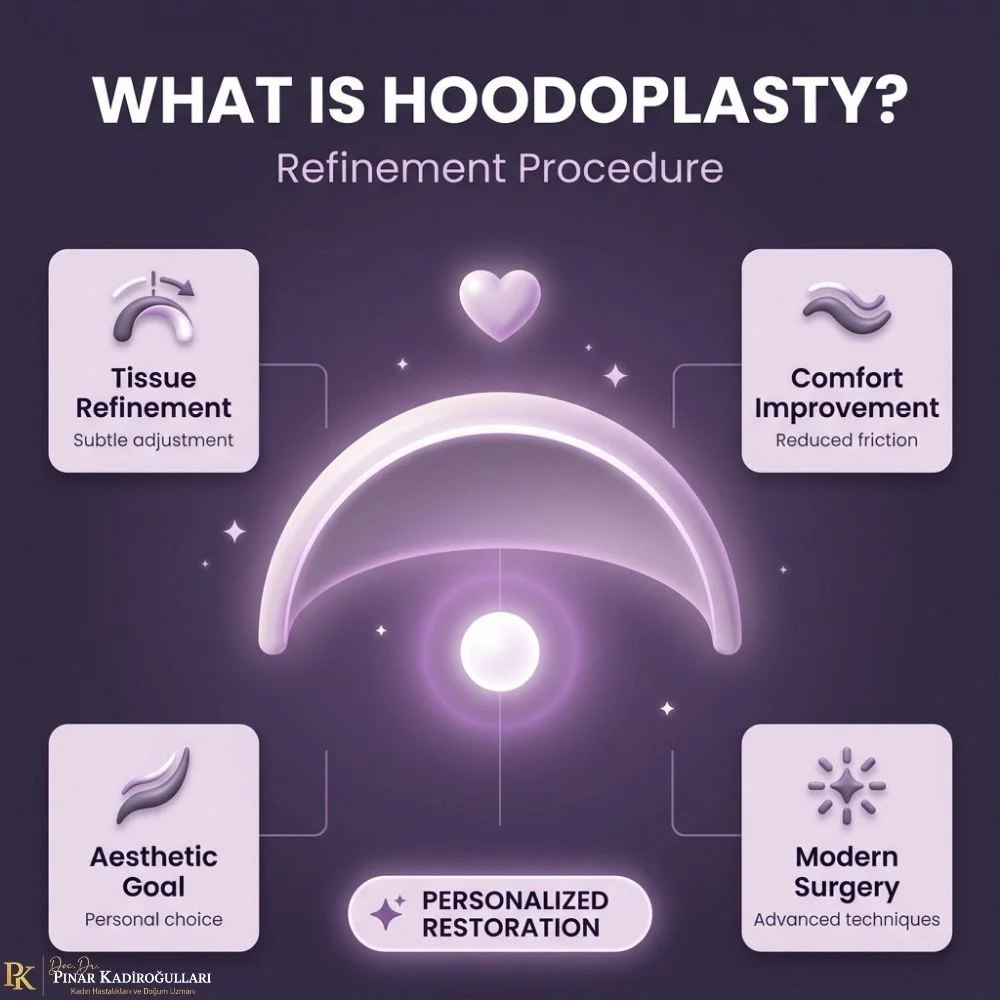
Hoodoplasty (clitoral hood aesthetics) is a surgical procedure for reducing or reshaping the skin fold known as the clitoral hood that covers the clitoris. This procedure is typically performed together with labiaplasty and complements the aesthetic harmony of the genital area.
In modern gynecological aesthetic surgical practice, a personalized surgical plan is developed in line with the guidelines of the ISSWSH and ISAPS, taking into account the size of the clitoral hood, asymmetry, and the patient’s expectations. At her practice in Nişantaşı, Istanbul, Assoc. Prof. Dr. Pınar Kadiroğulları plans the surgical approach according to the size of the clitoral hood, asymmetry, and the patient’s expectations.
Information Note
Hoodoplasty is performed on the skin covering the clitoris. Changes in sensation can occur after surgery; this is discussed with your physician beforehand. It can also be performed in the same session as labiaplasty.
What Is Hoodoplasty and the Anatomy of the Clitoral Hood
Hoodoplasty (clitoral hood reduction) is a surgical procedure for the reduction or reshaping of the skin fold known as the “clitoral hood” that covers the clitoris. Also referred to as “preputioplasty” in the medical literature, this procedure is a type of genital aesthetic surgery.
What Is the Clitoral Hood?
The clitoral hood is the skin fold that covers the clitoris in the female genital area. It is the anatomical counterpart of the foreskin (prepuce) in men. Together with the clitoris, it plays a protective and stimulating role in the mechanism of sexual pleasure. In some women, the hood may be excessively loose, wide, or asymmetrical. In such cases, hoodoplasty may be necessary.
Causes of Hood Anomalies
- Genetic predisposition: Inherited anatomical features
- Hormonal changes (puberty, pregnancy)
- Age-related loss of elasticity
- Skin laxity following significant weight loss
- Postpartum hormonal changes
- Chronic mechanical irritation and trauma
- Asymmetric development (left-right differences)
Types of Hoodoplasty
- Hood reduction: Removal of excess skin
- Hood reshaping: Correction of asymmetry
Important Information
Hoodoplasty is performed on the skin covering the clitoris. As with any surgery, there is a risk of changes in sensation; the possible effects on sexual function are discussed with your physician before the procedure.
In Which Cases Is Hoodoplasty Performed?
The decision for hoodoplasty is made based on the patient’s clinical complaints and aesthetic expectations. An excessively wide, sagging, or asymmetrical hood may lead to both functional and aesthetic problems. Hoodoplasty is recommended in the following situations.
1. Sexual Health Issues
- Difficulty with clitoral stimulation (when the hood is too thick)
- Insufficient arousal during sexual intercourse
- Difficulty achieving orgasm (anorgasmia)
- Difficulty with direct clitoral contact
- Decreased sexual pleasure
- Reduced satisfaction during sexual intercourse
2. Aesthetic Concerns
- Marked sagging or enlarged appearance of the hood
- Marked asymmetry between the right and left sides
- Excess skin folds (visible bulging)
- Anatomical changes after childbirth
- Visible volume in bikinis or swimsuits
- Loss of genital self-confidence
3. Physical Discomfort
- Friction-related irritation from tight clothing or underwear
- Smegma accumulation beneath the hood (hygiene difficulties)
- Discomfort during sports (especially cycling)
- Chronic vaginal irritation
- Foul odor and increased risk of infection
4. Other Concurrent Procedures
- Combined with labiaplasty (the most common combination). For details, you can visit our Labiaplasty page.
- Combined with vaginoplasty
- Combination with mons pubis aesthetics
- Performed together with G-Shot application
Diagnosis and Evaluation
The decision for hoodoplasty is made through a detailed examination. The size of the hood, the degree of sagging, asymmetry, and any accompanying pathologies are evaluated. The procedure is not performed on patients under 18 years of age. Whether it is performed together with labiaplasty is decided after examination.

Hoodoplasty Methods
The method of hoodoplasty is determined by considering the patient’s hood structure, degree of asymmetry, and aesthetic expectations. Vertical and horizontal incision techniques are described; the choice is made individually.
Method 1
Vertical Hoodoplasty
A classical method in which excess skin of the hood is removed through a vertical incision along the midline.
- Indications: Marked sagging and symmetric enlargement.
- Duration: 30-45 minutes, performed under local anesthesia.
- Discharge: Same day, with 3-5 days of rest.
- Features: Straightforward technique; the recovery period varies from person to person.
- Limitations: Additional tissue procedures may be required in cases of excessive sagging.
Method 2
Horizontal Hoodoplasty
A method in which the hood is reduced through horizontal incisions, requiring a more delicate technique.
- Indications: Asymmetry, excessive width, and cases where a natural appearance is desired.
- Duration: 45-60 minutes, performed under sedation.
- Discharge: Same day, with 5-7 days of rest.
- Features: The natural border is preserved.
- Limitations: Requires a more delicate technique.

Recovery and Sexual Pleasure After Hoodoplasty
The recovery process after hoodoplasty varies from person to person. Patients are typically discharged on the same day. Changes in sensation can occur after surgery; the possible effects on sexual function are discussed with your physician.
Typical Recovery Timeline
- First 24-48 hours: Mild swelling and pain, manageable with painkillers.
- 3-5 days: Swelling subsides; light activity is possible.
- 1 week: Return to office work.
- 2-3 weeks: Light sports activities can be resumed.
- 4-6 weeks: Doctor’s approval for sexual intercourse.
Postoperative Care
- First week: Tight clothing and tight pants are prohibited
- Since dissolvable sutures are used, suture removal is not required
- Bathing: Standing showers are allowed; bathtubs, swimming pools, and the sea are prohibited for 4-6 weeks
- Antiseptic care: A cleansing solution recommended by the doctor
- Loose, cotton underwear
- Cycling and horseback riding: After 6 weeks
Hoodoplasty and Sexual Pleasure
⚠️ When to Consult a Physician
- Fever above 38°C or chills
- Severe and persistent pain
- Excessive or clotted bleeding
- Wound dehiscence, discharge, or foul odor at the suture site
- Excessive swelling or increasing bruising
- Loss of clitoral sensitivity (very rare)
Important Reminder
Results and effects on sexual function vary from person to person. You can consult your doctor about combining the procedure with labiaplasty or vaginoplasty.

Frequently Asked Questions
Does hoodoplasty cause damage to the clitoris?
The procedure is performed on the skin (hood) covering the clitoris and is not intended to affect the clitoris itself. However, as with any surgery, there is a risk of changes in sensation; the possible effects on sexual function are discussed with your physician before the procedure.
Can hoodoplasty be performed alone?
Yes, hoodoplasty can be performed alone. Whether it is combined with labiaplasty is decided after examination. As a standalone procedure, hoodoplasty is performed as a short procedure of 30-45 minutes in cases of marked sagging or asymmetry of the hood. Concurrent procedures offer the advantage of a single anesthesia session and a single recovery period.
What is the recovery time after hoodoplasty?
Recovery from hoodoplasty takes 2-4 weeks. Mild swelling occurs in the first 24-48 hours, and normal activity is possible within 3-5 days. Patients can return to office work after 1 week, light sports after 2-3 weeks, and sexual intercourse after 4-6 weeks. Since dissolvable sutures are used, suture removal is not required. The final aesthetic results become apparent within 2-3 months.
Will scars remain after hoodoplasty?
Dissolvable sutures are used, and incision marks usually fade over time; scar appearance varies from person to person. Following your doctor’s aftercare recommendations supports healing.
At what age can hoodoplasty be performed?
The procedure is not performed on patients under 18 years of age, as their development is not yet complete. There is no upper age limit; the procedure can also be performed on postmenopausal women if their general health is suitable. The decision is based not on age but on the patient’s clinical complaints and psychological readiness. Suitability for the procedure is determined through a detailed examination.
Our Treatments




References
The medical content on this page has been prepared based on the current clinical guidelines and scientific publications of national and international authoritative organizations. An academic article by Assoc. Prof. Dr. Pınar Kadiroğulları on clitoral hoodoplasty is also listed among the references.
The Inverted-Y Plasty Technique in Clitoral Hoodoplasty Operations: Surgical Method and Outcomes
Publication: Journal of Minimally Invasive Gynecology 2021 | Study: Case series of 63 patients, Turkish academics | Source Type: Peer-Reviewed Clinical Research (PubMed)
The Impact of Technique Selection in Labiaplasty Surgery: An Analysis of Aesthetic and Functional Outcomes
Authors: Uçar E, Bestel M, Uçar BH, Doğan O (Turkish academics) | Publication: Journal of Clinical Medicine 2025 | Source Type: Peer-Reviewed Clinical Study (PubMed PMC, Full Text)
Elective Female Genital Cosmetic Surgery — Committee Opinion No. 795
Author: American College of Obstetricians and Gynecologists (ACOG) | Publication: Obstet Gynecol 2020 | Source Type: Committee Opinion / Standards for Female Genital Aesthetic Surgery
Hoodplasty: An Individualized Approach to Labiaplasty
Publication: Aesthetic Plastic Surgery 2024 | Source Type: Peer-Reviewed Surgical Technique Article (PubMed)
Aesthetic Labia Minora and Clitoral Hood Reduction: The Extended Central Wedge Resection
Author: Alter GJ | Publication: Plastic and Reconstructive Surgery 2008 | Source Type: Peer-Reviewed Clinical Study of 407 Patients (PubMed)
Motivational Factors for Labiaplasty: A Systematic Medical Research Review
Publication: Journal of Clinical Medicine 2025 | Source Type: Systematic Review (PubMed PMC, Full Text)
Clitoral Hood Reduction: A Surgical Approach
Publication: Aesthetic Surgery Journal 2016 (American Society for Aesthetic Plastic Surgery) | Source Type: Peer-Reviewed Surgical Technique Article (PubMed)
⭐ Academic Publication by Assoc. Prof. Dr. Pınar Kadiroğulları on Hoodoplasty
Scientific publication co-authored by Assoc. Prof. Dr. Pınar Kadiroğulları, directly related to the topic of this page
Clitoral Hoodoplasty Techniques: Patient Selection, Indications, and the Impact on Sexual Function — A Review
Authors: Bozkurt Köseoğlu S, Çalışkan E, Kadiroğulları P | Publication: Anatolian Journal of Obstetrics and Gynecology Research 2024 | Source Type: Turkish-English Peer-Reviewed Review
📍 This publication addresses in detail the entire spectrum of hoodoplasty techniques and their impact on sexual function.
The Effect of Dydrogesterone Treatment on Sexual Function (FSFI) in Women with Endometriosis
Authors: Yalçın Bahat P, Yücel B, Yuksel Özgör B, Kadiroğulları P, Topbas Selçuki NF, Çakmak K | Publication: Journal of Obstetrics and Gynaecology 2022;42(5):1276-1279 | Source Type: Peer-Reviewed Clinical Research (PubMed)
Modified Extraperitoneal Uterosacral Ligament Suspension: Preventing Vaginal Cuff Prolapse After Vaginal Hysterectomy — A 4-Clamp Technique
Authors: Kadiroğulları P, Seçkin KD | Publication: Journal of Investigative Surgery 2019 | Source Type: Peer-Reviewed Clinical Research (PubMed)
Important Note
The information on this page is intended for general informational purposes and does not replace individual medical advice. For personal questions regarding the diagnosis of hoodoplasty (clitoral hood reduction), surgical planning, and your health, you should always consult your specialist gynecologist. The content of this page has been prepared by Assoc. Prof. Dr. Pınar Kadiroğulları in light of clinical experience and current scientific literature.
“Obstetrics and Gynecology”