


Assoc. Prof. Dr. Pınar Kadiroğulları
Assoc. Prof. Dr. Pınar Kadiroğulları is a specialist in obstetrics and gynecology. She works in the areas of pregnancy monitoring, HPV and cervical health, genital aesthetics, and gynecological surgery.
Her approach is based on current scientific guidelines.
Uterine polyp surgery (hysteroscopic polypectomy) refers to the surgical removal of polyps developing from the uterine lining (endometrium). Uterine polyps are seen in women of reproductive age, and the need for surgery is decided according to the individual case.
In modern gynecological surgical practice, a personalized surgical plan is developed in line with the guidelines of the AAGL and ESGE, taking into account the size and number of polyps, the patient’s age, and her symptoms. At her practice in Nişantaşı, Istanbul, Assoc. Prof. Dr. Pınar Kadiroğulları plans the surgical approach according to the size and number of polyps, the patient’s age, and symptoms.
Information Note
Uterine polyp surgery is performed hysteroscopically, without an abdominal incision. The duration and discharge plan depend on the individual case. For detailed information on the hysteroscopic method, you can visit our Hysteroscopy page.
What Is a Uterine Polyp and Why Does It Develop?
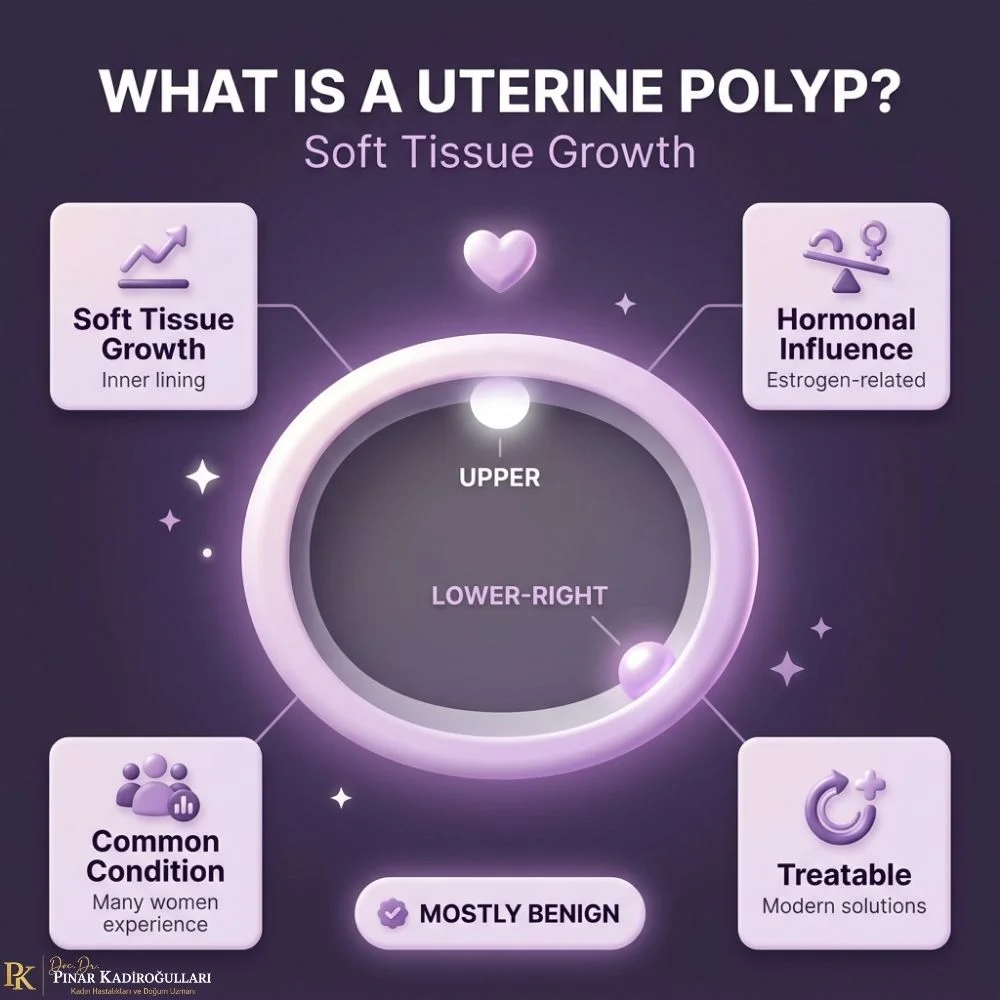
A uterine polyp (endometrial polyp) is a pedunculated or broad-based benign tissue overgrowth that develops as a result of the excessive growth of the uterine lining (endometrium) extending into the uterine cavity. Their size can range from millimeters to centimeters, and they may occur as single or multiple lesions.
Uterine polyps are hormone-sensitive structures and grow particularly under the influence of estrogen. While the majority are benign, polyps may rarely show malignant (cancerous) change; the physician decides whether removal and pathological examination are needed.
Types of Uterine Polyps
1. Endometrial Polyp: Develops from the uterine lining and is the most common type. It can be pedunculated (with a stalk) or sessile (broad-based).
2. Cervical Polyp: A polyp that develops from the cervix, sometimes extending into the vagina. It can usually be removed during a simple examination.
Risk Factors
- Excess estrogen: Hormonal imbalance is the main risk factor
- Advanced age: The frequency of polyps increases especially between the ages of 40 and 50
- Obesity: The risk increases as adipose tissue produces estrogen
- An association with hypertension has been identified
- Tamoxifen use (in breast cancer treatment)
- Long-term hormone replacement therapy
- Genetic predisposition and family history
Symptoms
- Irregular menstrual bleeding and intermenstrual bleeding
- Heavy or prolonged menstrual bleeding
- Spotting or brown discharge after menstruation
- Postmenopausal bleeding
- Bleeding after intercourse
- Infertility and recurrent pregnancy loss
- Many polyps may remain asymptomatic
Important Information
Hysteroscopy is a widely used method in the diagnosis of uterine polyps. A detailed evaluation is performed using transvaginal ultrasound, saline infusion sonohysterography, and hysteroscopy. The size, number, and location of the polyp are important in surgical planning.
In Which Cases Is Uterine Polyp Surgery Necessary?
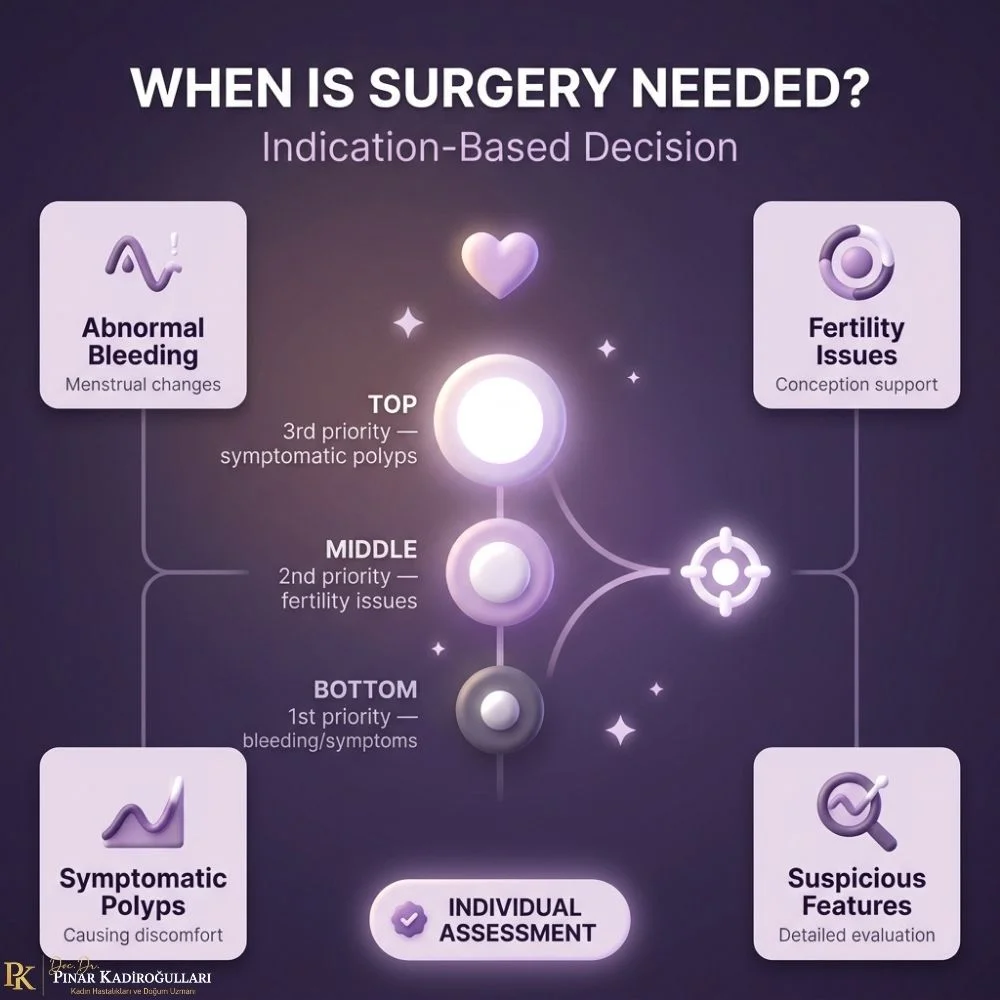
The decision for uterine polyp surgery is made based on the polyp’s size, number, the patient’s age, and symptoms. The need for surgical removal is decided individually, considering the risk of bleeding irregularities, infertility, or malignancy. Obtaining a tissue sample for pathological examination is also important.
1. Clinical Symptoms
- Irregular menstrual bleeding and intermenstrual bleeding
- Heavy or prolonged menstrual bleeding (menorrhagia)
- Spotting or brown discharge after menstruation
- Postmenopausal bleeding
- Bleeding after intercourse (postcoital)
- Bleeding causing iron deficiency anemia
2. Reproductive and Pregnancy Issues
- Infertility (especially in the presence of polyps larger than 1 cm)
- Recurrent pregnancy loss
- Uterine preparation prior to IVF
- Evaluation of unexplained infertility
- A history of preterm birth
3. Structural Features of the Polyp
- Polyps larger than 1 cm (a priority in all cases)
- The presence of multiple polyps
- Suspicious imaging or increased vascularization on ultrasound
- Rapidly growing polyps
- Polyps detected in patients using tamoxifen
4. High-Risk Patients
- Polyps detected in the postmenopausal period (risk of cancer)
- Patients over the age of 60
- A family history of endometrial cancer
- Carriers of Lynch syndrome
- Coexisting hypertension and diabetes
Diagnostic Process
The diagnosis of a uterine polyp is made through a gynecological examination, transvaginal ultrasound, and saline infusion sonohysterography. Hysteroscopy is a method that allows both diagnosis and treatment in the same session. Polyps are sent for pathological examination to definitively determine whether they are malignant.
Uterine Polyp Surgical Methods
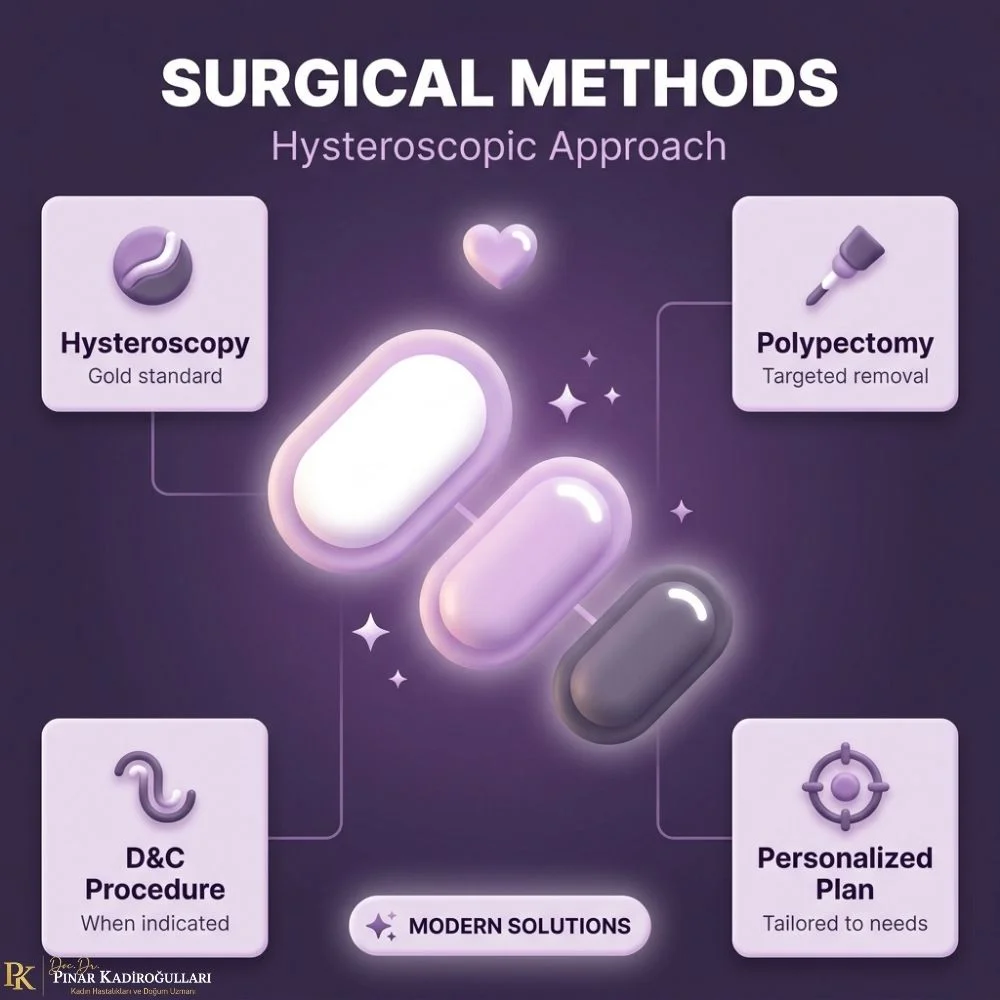
The method of uterine polyp surgery is determined by considering the polyp’s location, size, and number. There are three main approaches: hysteroscopic polypectomy, office hysteroscopy, and classical dilation and curettage.
Method 1
Hysteroscopic Polypectomy (Incision-Free)
A method in which the polyp is removed without an abdominal incision under camera guidance through the cervix.
- Indications: Endometrial polyps, as decided by the physician.
- Duration: 15-30 minutes, performed under sedation or mild anesthesia.
- Discharge: Same day, with a return to normal life within 1-2 days.
- Features: No abdominal incision; removal under direct visualization.
- Limitations: Careful planning may be required for very large polyps.
Method 2
Office Hysteroscopy (See and Treat)
A method performed using thin hysteroscopes in an outpatient setting, sometimes without anesthesia.
- Indications: Small polyps (under 1 cm) and pedunculated polyps.
- Duration: 5-15 minutes, no anesthesia required.
- Discharge: Patients can return home within 30 minutes and to work the next day.
- Features: May not require anesthesia; the return to daily life varies from person to person.
- Limitations: Suitable only for small and appropriate polyps.
Method 3 – Classical (Limited Use)
Dilation and Curettage (D&C)
A traditional method in which the cervix is dilated and the uterine cavity is scraped blindly with specialized curettes.
- Indications: Heavy bleeding, emergency situations, and multiple polyps.
- Duration: 15-20 minutes, performed under general anesthesia.
- Discharge: Same day, with a return to normal life within 1-2 days.
- Features: Short procedure time.
- Limitations: Performed blindly, the polyp may not be completely removed.
Recovery and Fertility After Uterine Polyp Surgery
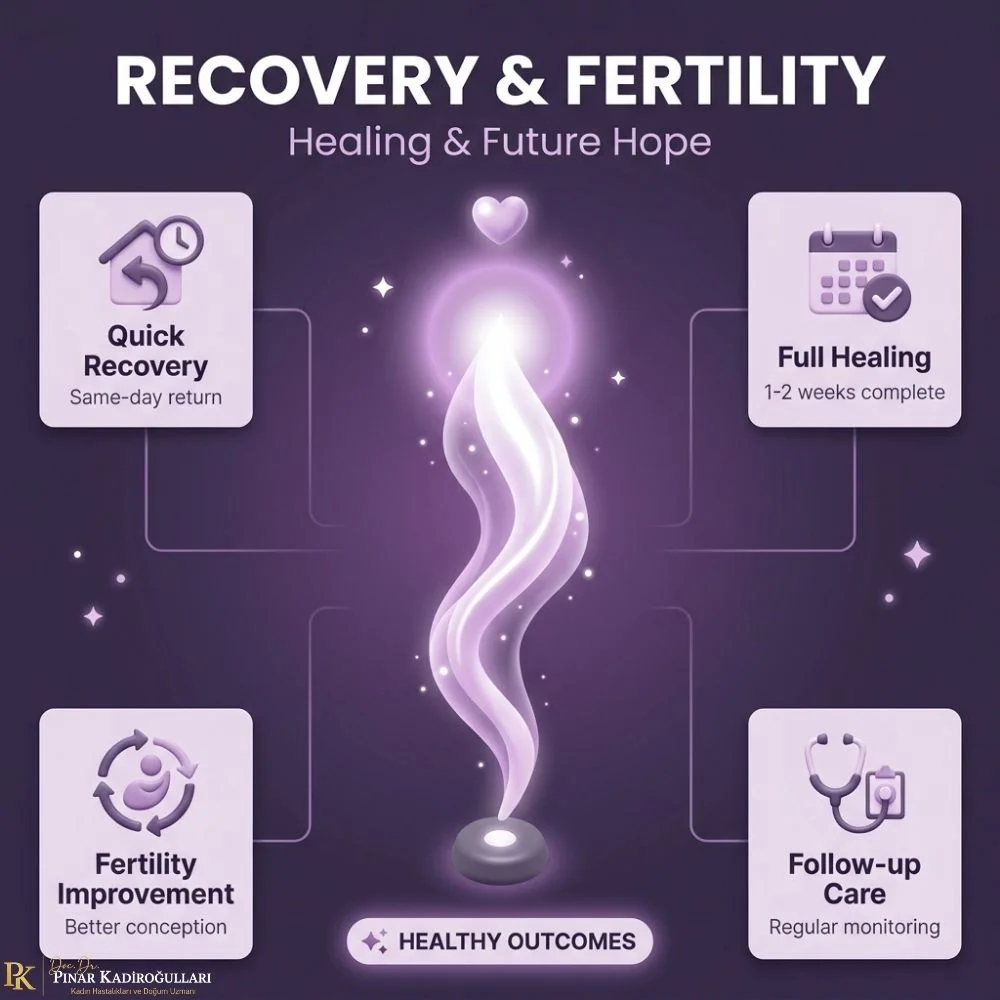
The recovery process after uterine polyp surgery varies from person to person. Patients are typically discharged on the same day.
Typical Recovery Timeline
- First 2-4 hours: Hospital observation, fluid intake, and discharge preparation.
- Same day: Discharge and rest at home.
- Next day: Return to normal activities.
- 2-3 days: Return to work and office tasks.
- 1 week: Full activity and follow-up examination.
Temporary Symptoms That May Occur
- Mild vaginal bleeding: Lasts 3-5 days, considered normal.
- Mild cramping pain (1-2 days)
- Nausea (anesthesia-related, short-lived)
- Brown discharge (resolves within 1 week)
Pregnancy After Polyp Surgery
- Waiting period: Pregnancy may be attempted after 1-2 months
- Polyp removal may be considered in cases of infertility; this is decided by the physician
- Polyp recurrence is possible
- The pathology results are reviewed with your physician
⚠️ When to Consult a Physician
- Fever above 38°C or chills
- Excessive or clotted vaginal bleeding
- Severe and persistent abdominal pain
- Foul-smelling vaginal discharge (a sign of infection)
- Fainting, dizziness, or general weakness
Important Reminder
Uterine polyp surgery is a surgical method; results vary from person to person. You can also visit our Infertility Treatment page.
Frequently Asked Questions
Is uterine polyp surgery always necessary?
Whether a polyp needs to be removed is decided by the physician according to its size, symptoms, and the patient’s age and risk factors. Polyps may cause irregular bleeding and infertility, and although rare, may show malignant change. Very small asymptomatic polyps may be monitored under the doctor’s evaluation.
How many minutes does uterine polyp surgery take?
The duration of uterine polyp surgery (hysteroscopic polypectomy) varies depending on the method used. Standard hysteroscopic polypectomy takes 15-30 minutes, office hysteroscopy takes 5-15 minutes, and dilation and curettage takes 15-20 minutes. The duration may extend in cases involving multiple or large polyps. This duration does not include pre-anesthesia preparation and post-anesthesia recovery.
When can I become pregnant after uterine polyp surgery?
The timing of a new pregnancy attempt after uterine polyp surgery is decided by your physician.
Can uterine polyps recur?
A new polyp may develop after surgery. Regular gynecological check-ups are important. Hormonal imbalance, obesity, and tamoxifen use increase the risk of recurrence. The development of new polyps is less common after menopause.
Will there be pain and bleeding after uterine polyp surgery?
Mild pain and bleeding after uterine polyp surgery are normal. Mild cramping pain may be felt for 1-2 days after surgery and can be managed with painkillers prescribed by your physician. Vaginal bleeding may last 3-5 days, and brown discharge may continue for up to a week, which is also normal. However, in case of heavy bleeding, clotted bleeding, fever, or foul-smelling discharge, you should always consult your physician.
Our Treatments
References
The medical content on this page has been prepared based on the current clinical guidelines and scientific publications of international and national authoritative organizations. Below, you can review the main PDF references cited and the academic publications of Assoc. Prof. Dr. Pınar Kadiroğulları.
AAGL Practice Report: Clinical Practice Guideline for the Diagnosis and Management of Endometrial Polyps
Author: American Association of Gynecologic Laparoscopists (AAGL) | Publication: J Minim Invasive Gynecol 2012;19:3-10 | Source Type: International Clinical Practice Guideline (PubMed)
SOGC Guideline No. 447: Diagnosis and Management of Endometrial Polyps
Author: Society of Obstetricians and Gynaecologists of Canada (SOGC) | Publication: Journal of Obstetrics and Gynaecology Canada 2024 | Source Type: Clinical Practice Guideline
The Use of Hysteroscopy for the Diagnosis and Treatment of Intrauterine Pathology
Author: American College of Obstetricians and Gynecologists (ACOG) | Publication: Committee Opinion 2020 | Source Type: ACOG Clinical Committee Opinion
British Fertility Society: Policy and Practice Guideline for the Management of Endometrial Polyps in Fertility
Author: British Fertility Society (BFS) | Publication: Human Fertility 2026 | Source Type: Clinical Practice Guideline
Office Hysteroscopic Polypectomy: A Comparison of Rigid and Semi-Rigid Hysteroscopes
Publication: Journal of Clinical Medicine 2023 | Source Type: Peer-Reviewed Comparative Clinical Study (PubMed PMC, Full Text)
Endometrial Resection with Hysteroscopic Polypectomy Prevents Polyp Recurrence: A Randomized Clinical Trial
Study: 94 patients, randomized single-blind trial | Source Type: Peer-Reviewed Randomized Clinical Trial (PubMed PMC)
Premalignant and Malignant Lesions in Patients Undergoing Hysteroscopic Polypectomy
Study: Retrospective analysis of 1,020 patients | Publication: Brazilian Journal of Gynecology 2014 | Source Type: Comprehensive Peer-Reviewed Clinical Study (PubMed PMC)
⭐ Academic Publications by Assoc. Prof. Dr. Pınar Kadiroğulları on Uterine Surgery
Publications authored by the doctor in the fields of uterine surgery, hysteroscopic procedures, and fertility preservation
Abdominal Hysterectomy with a Uterine Manipulator: A Randomized Controlled Clinical Trial
Authors: Kıyak H, Karacan T, Özyürek ES, Türkgeldi LS, Kadiroğulları P, Seçkin KD | Publication: Journal of Investigative Surgery 2021;34(10):1052-1058 | Source Type: Randomized Controlled Clinical Trial (PubMed)
📍 This publication directly addresses uterine surgery
Evaluation of the Relationship Between HbA1c Levels and Ovarian Reserve in Type 1 Diabetes Patients
Authors: Kadiroğulları P, Demir E, Bahat PY, Kıyak H, Seçkin KD | Publication: Gynecological Endocrinology 2020;36(5):426-430 | Source Type: Peer-Reviewed Scientific Article (PubMed)
Modified Extraperitoneal Uterosacral Ligament Suspension: A 4-Clamp Technique After Vaginal Hysterectomy
Authors: Kadiroğulları P, Seçkin KD | Publication: Journal of Investigative Surgery 2019 | Source Type: Peer-Reviewed Clinical Research (PubMed)
Important Note
The information on this page is intended for general informational purposes and does not replace individual medical advice. For personal questions regarding the diagnosis of uterine polyps, the planning of hysteroscopic polypectomy, and your health, you should always consult your specialist gynecologist. The content of this page has been prepared by Assoc. Prof. Dr. Pınar Kadiroğulları in light of clinical experience and current scientific literature.
“Obstetrics and Gynecology”