

Assoc. Prof. Dr. Pınar Kadiroğulları
Assoc. Prof. Dr. Pınar Kadiroğulları is a specialist in obstetrics and gynecology. She works in the areas of pregnancy monitoring, HPV and cervical health, genital aesthetics, and gynecological surgery.
Her approach is based on current scientific guidelines.
Menstrual irregularity treatment is an important issue that closely concerns women’s health and negatively impacts quality of life. Many women experience menstrual irregularities at some point in their lives; this condition can sometimes be the first sign of an underlying health problem.
In modern gynecological practice, a personalized treatment plan is developed in accordance with ACOG and ESHRE guidelines, taking into account the type of irregularity, the patient’s age, fertility goals, and accompanying symptoms. At her practice in Nişantaşı, Istanbul, Assoc. Prof. Dr. Pınar Kadiroğulları evaluates menstrual irregularities from diagnosis to treatment, from hormonal imbalances to structural problems.
Information Note
A healthy menstrual cycle ranges between 21 and 35 days, and bleeding lasts for 2 to 7 days. Irregularities outside these limits or changes lasting more than 3 months should be evaluated. Information on the PCOS Treatment page may also be useful.
What Is Menstrual Irregularity?
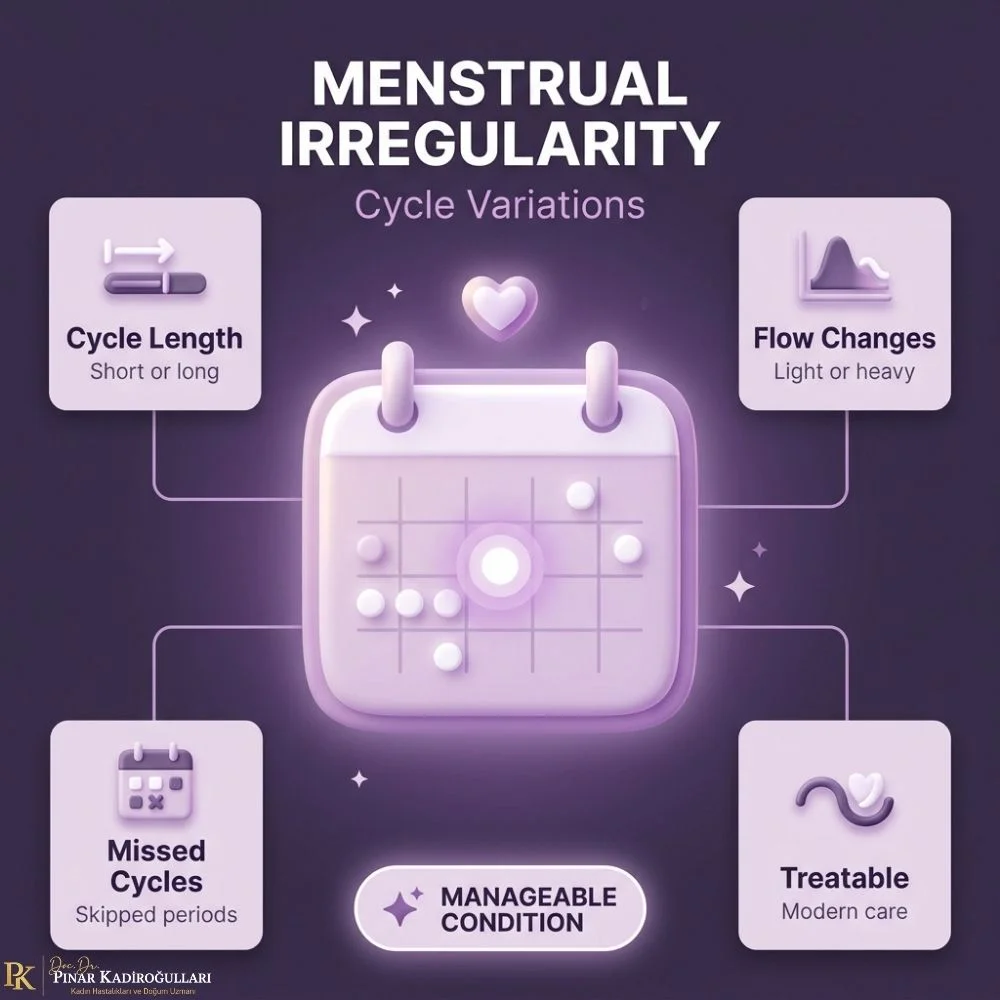
Menstrual irregularity describes deviations from the normal cycle of the female reproductive system. In a healthy menstrual cycle, bleeding occurs at intervals of 21-35 days and lasts for 2-7 days. Bleeding that falls outside these limits—delayed, frequent, excessive, light, or completely absent—is considered menstrual irregularity.
This condition often develops due to hormonal imbalances, structural problems, or lifestyle factors. The primary goals within the scope of menstrual irregularity treatment are as follows:
1. Identifying the Underlying Cause: The root cause is determined through detailed medical history, gynecological examination, hormone tests, and ultrasound.
2. Improving Quality of Life: Controlling the amount of bleeding, pain, and psychological effects.
3. Preserving Fertility: Protecting reproductive health and providing treatment when necessary for patients who wish to conceive.
Important Information
Menstrual irregularity during the first 1-2 years of adolescence and the premenopausal period is usually due to hormonal transition processes and is normal. However, during the reproductive period, irregularities continuing for more than 3 months, excessive bleeding, or the absence of menstruation for more than 3 months must be evaluated.
Types and Causes of Menstrual Irregularities
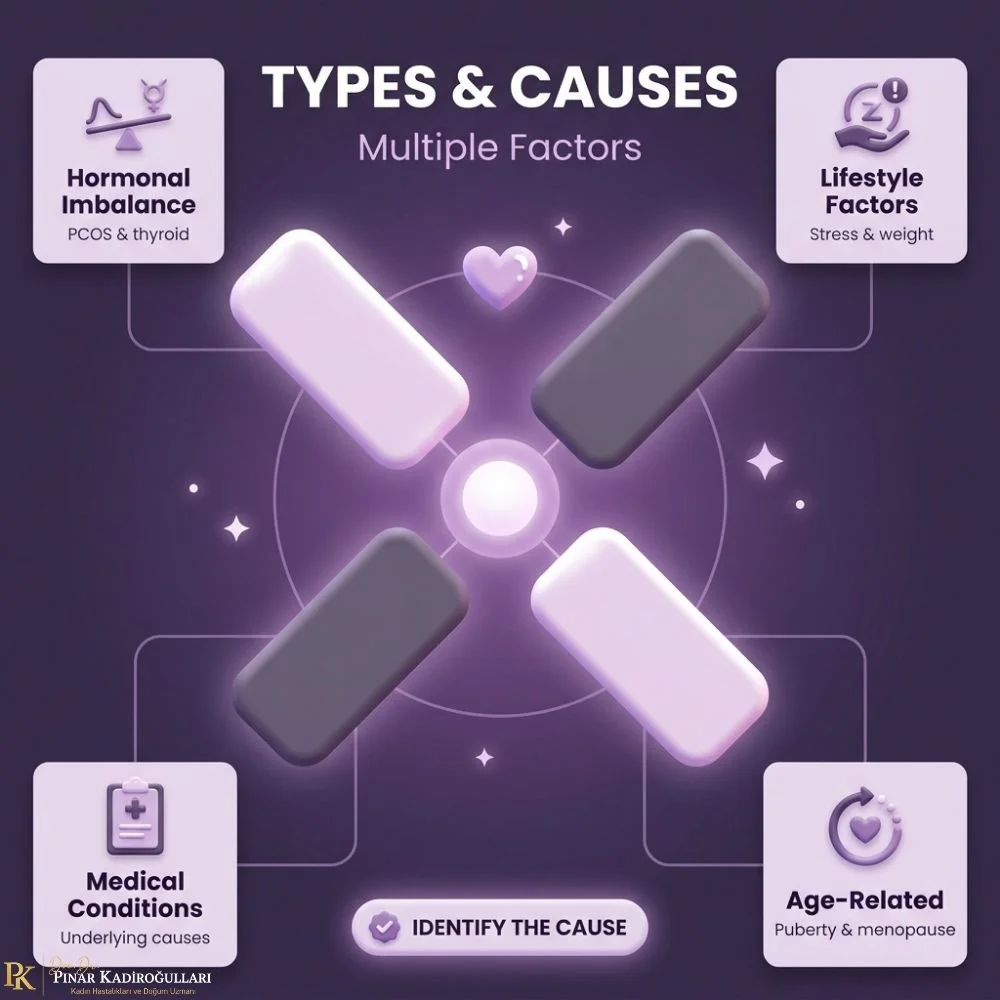
Accurate identification is important in menstrual irregularity treatment. In clinical practice, menstrual irregularity is divided into various subtypes based on the bleeding pattern, and each may have different causes.
1. Types of Menstrual Irregularities
- Amenorrhea: Absence of menstruation for 3 months or longer
- Oligomenorrhea: Infrequent periods with intervals longer than 35 days
- Polymenorrhea: Frequent periods with intervals shorter than 21 days
- Menorrhagia: Excessive bleeding or bleeding lasting longer than 7 days
- Metrorrhagia: Irregularly spaced, intermenstrual bleeding
- Menometrorrhagia: Irregular bleeding that is both excessive and prolonged
- Hypomenorrhea: Unusually light bleeding
2. Most Common Causes
- Hormonal imbalances: Changes in estrogen and progesterone levels
- Polycystic ovary syndrome (PCOS): The most common hormonal disorder
- Thyroid diseases: Hypothyroidism and hyperthyroidism
- Elevated prolactin: Excess of the milk hormone
- Structural problems: Fibroids, polyps, endometriosis, adenomyosis
- Lifestyle factors: Excessive stress, sudden weight change, intense exercise
- Medications: Birth control pills, IUDs, certain psychiatric medications
- Eating disorders: Anorexia, bulimia
3. Accompanying Symptoms
- Severe menstrual pain (dysmenorrhea)
- Premenstrual syndrome (PMS) symptoms
- Anemia and fatigue
- Skin and hair problems (acne, hirsutism, hair loss)
- Weight changes
- Pregnancy problems and infertility
Doctor’s Advice
Menstrual irregularity is often a symptom of another underlying health problem. Therefore, it is essential not only to correct the irregularity but also to identify the root cause. A detailed examination and, if necessary, hormone tests are important for correct treatment.
Menstrual Irregularity Treatment Methods
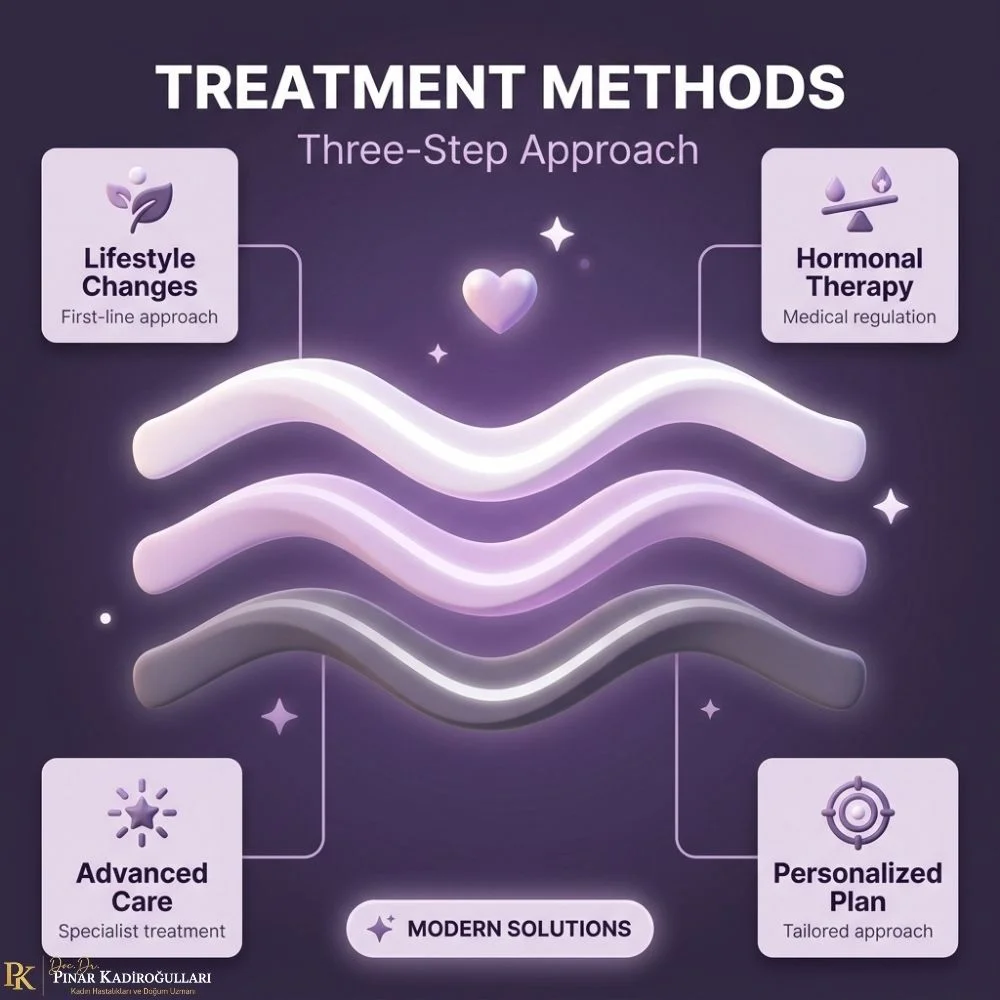
Menstrual irregularity treatment is planned with a stepwise approach depending on the underlying cause, the patient’s age, fertility goals, and the severity of symptoms. The treatment plan is completely personalized, and non-surgical methods are generally preferred as the first step.
Step 1 Treatment
Lifestyle and Supportive Treatments
- Healthy Weight Management: A healthy body weight supports hormonal balance.
- Stress Management: Hormone balance through yoga, meditation, and regular sleep.
- Balanced Diet: A varied, balanced diet is recommended; supplement use should be discussed with your physician.
- Moderate Exercise: Moderate-intensity, regular exercise supports the menstrual cycle.
Step 2 Treatment
Hormonal Medication
- Birth Control Pills: May be used to regulate menstruation; decided by the physician.
- Progesterone Therapy: Cyclic use to ensure regular menstruation.
- Hormonal IUD: A hormonal intrauterine system may be considered for excessive bleeding; the response varies from person to person.
- Thyroid/Prolactin Treatment: Correcting the underlying hormonal issue.
Step 3 Treatment
Surgical and Advanced Treatments
- Hysteroscopy: Minimally invasive removal of intrauterine polyps and fibroids.
- Laparoscopic Myomectomy: Minimally invasive surgery for extrauterine fibroids.
- Endometrial Ablation: Ablation of the uterine lining for excessive bleeding.
- Hysterectomy at an Advanced Age: The last resort for cases unresponsive to other treatments.
Lifestyle Recommendations and Prevention
During the menstrual irregularity treatment process, lifestyle adjustments may help in supporting hormonal balance. The following recommendations are supported by ACOG and ESHRE on an evidence-based level.
Nutritional Recommendations
- Iron-rich foods: Red meat, dried legumes, leafy green vegetables.
- A balanced, varied diet is recommended.
- B vitamins: Whole grains, eggs, dairy products.
- Limit caffeine and sugar — they can increase hormone fluctuations.
- Avoid processed foods — trans fats increase inflammation.
Lifestyle Adjustments
- Regular sleep: 7-9 hours a day; the melatonin cycle supports hormonal balance.
- Stress management: Practice yoga, meditation, and breathing exercises.
- Regular exercise: 150 minutes of moderate-intensity exercise per week is sufficient.
- Avoid excessive exercise — it can cause menstruation to stop.
- Track your period: Record your cycle using mobile applications.
- Stay away from smoking and alcohol — they disrupt hormone balance.
⚠️ When to Consult a Doctor
- No menstruation for over 3 months (excluding pregnancy)
- Excessive bleeding (if you need to change a pad every hour)
- Bleeding lasting longer than 7 days
- Intermenstrual bleeding between periods
- Severe menstrual pain (affecting work/daily life)
- Bleeding after sexual intercourse
- Postmenopausal bleeding (requires urgent evaluation)
Important Reminder
Menstrual irregularity can be managed with the right diagnosis and an appropriate treatment plan; results vary from person to person. Early evaluation is important.

Frequently Asked Questions
When Does Menstrual Irregularity Require Treatment?
Menstrual irregularity treatment is necessary for women whose menstrual intervals are consistently shorter than 21 days or longer than 35 days, whose bleeding lasts longer than 7 days, who experience excessive bleeding, or who have not menstruated for more than 3 months. Additionally, bleeding after sexual intercourse, intermenstrual bleeding, or postmenopausal bleeding must be evaluated.
Do Birth Control Pills Regulate Menstrual Irregularities?
Birth control pills may be used in some cases of menstrual irregularity. They can help regulate menstruation, reduce the amount of bleeding, and ease menstrual pain; the response varies from person to person. However, different treatment methods are preferred for patients who wish to conceive or have hormonal contraindications. The decision to use pills should be made after an expert evaluation.
Does Stress Disrupt the Menstrual Cycle?
Yes, stress can directly affect the menstrual cycle. Intense physical or emotional stress can disrupt the balance in the brain’s hypothalamus-pituitary-ovarian axis, causing delayed, missed, or irregular periods. Yoga, meditation, regular sleep, and stress management play a supportive role in restoring hormonal balance.
Does Menstrual Irregularity Prevent Pregnancy?
Irregular menstruation can indicate an ovulation problem, and this condition can reduce the chances of pregnancy. Irregularities caused particularly by PCOS and thyroid diseases can lead to infertility. With the correct diagnosis and appropriate treatment, pregnancy may be possible naturally or with assisted reproductive techniques. Early evaluation is important for women who wish to conceive.
Which Menstrual Irregularity Symptoms Are Considered Serious?
Symptoms requiring urgent evaluation include: postmenopausal bleeding, excessive bleeding requiring a pad change every hour, excessive bleeding accompanied by dizziness or fatigue, sudden onset of severe pelvic pain, and bleeding after sexual intercourse. These conditions can be a sign of an underlying problem; they should be evaluated by a physician without delay.
Our Treatments




References
The medical content on this page is prepared based on the current clinical guidelines and scientific publications of international and national authoritative organizations. The publications of Assoc. Prof. Dr. Pınar Kadiroğulları in the fields of ovarian function and uterine surgery are also listed among the references.
FIGO PALM-COEIN Classification System (2018 Revision): Abnormal Uterine Bleeding
Source Author: Munro MG, Critchley HOD, Fraser IS — FIGO Menstrual Disorders Committee | Publication: International Journal of Gynecology & Obstetrics 2018;143(3):393-408 | Source Type: International Classification System (PubMed)
The Two FIGO Systems: Normal and Abnormal Uterine Bleeding Symptoms & Classification of Causes — Full Text
Source Author: Munro MG, Critchley HOD, Fraser IS, et al. (FIGO Menstrual Disorders Committee) | Publication: Wiley Online Library — IJGO | Source Type: FIGO PALM-COEIN Full Official Text
NICE NG88: Heavy Menstrual Bleeding Assessment and Management — UK National Clinical Guideline
Source Author: National Institute for Health and Care Excellence (NICE) | Publication: NICE Guideline NG88 (2018, 2021 update) | Source Type: National Clinical Guideline (PDF)
Evaluation of Patients with Abnormal Uterine Bleeding According to the PALM-COEIN Classification
Authors: Turkish Academics — Istanbul Medipol University & Kanuni Sultan Suleyman Training and Research Hospital | Publication: Istanbul Medical Journal 2019 | Study: 403 Turkish women aged 15-45, prospective | Source Type: Turkish Peer-Reviewed Clinical Study
Abnormal Uterine Bleeding and PALM-COEIN Classification: Tertiary Center Experience
Author Institution: Keçiören Training and Research Hospital, Ankara, Türkiye | Publication: Turkish Journal of Women’s Health and Neonatology 2022 | Study: 135 patients retrospective analysis | Source Type: Turkish Peer-Reviewed Clinical Study
Types of Abnormal Uterine Bleeding According to the PALM-COEIN FIGO Classification: A Clinical Study
Publication: Journal of the Turkish-German Gynecological Association (JTGGA) 2021 | Source Type: Turkish-German Peer-Reviewed Scientific Study (Journal affiliated with TJOD)
FIGO PALM-COEIN Original Classification System (2011): Causes of AUB in the Reproductive Years
Source Author: Munro MG, Critchley HOD, Fraser IS — FIGO Menstrual Disorders Working Group | Publication: Int J Gynaecol Obstet 2011 | Source Type: FIGO Original Classification Document (PubMed)
⭐ Academic Publications of Assoc. Prof. Dr. Pınar Kadiroğulları on Menstrual Irregularity
The doctor’s publications regarding the causes of menstrual irregularity according to the PALM-COEIN system (AUB-O ovarian dysfunction, AUB-L leiomyoma, AUB-P polyp)
The Relationship Between HbA1c Levels and Ovarian Reserve: An Ovarian Dysfunction Study
Authors: Kadiroğulları P, Demir E, Bahat PY, Kıyak H, Seçkin KD | Publication: Gynecological Endocrinology 2020;36(5):426-430 | Source Type: Peer-Reviewed Scientific Article (PubMed)
📍
Abdominal Hysterectomy with Uterine Manipulator: RCT in AUB-L (Leiomyoma) and Other Surgical Indications
Authors: Kıyak H, Karacan T, Özyürek ES, Türkgeldi LS, Kadiroğulları P, Seçkin KD | Publication: Journal of Investigative Surgery 2021;34(10):1052-1058 | Source Type: Randomized Controlled Clinical Trial (PubMed)
The Relationship of Endometriomas and Dermoid Cysts with Menstrual Irregularity: A Laparoscopic Approach
Authors: Kıyak H, Kadiroğulları P, Karacan T, Seçkin KD, Karataş S | Publication: CRSLS – Journal of the Society of Laparoendoscopic Surgeons 2019 | Source Type: Peer-Reviewed Case Report (Relationship between endometrioma and menstrual pain/irregularity)
Important Note
The information on this page is for general informational purposes only and does not substitute for individual medical advice. For your personal questions regarding menstrual irregularity, the diagnosis of abnormal uterine bleeding, and treatment planning, please consult your specialist gynecologist. The page content has been prepared by Assoc. Prof. Dr. Pınar Kadiroğulları in light of clinical experience and current scientific literature.
“Obstetrics and Gynecology”