





Assoc. Prof. Dr. Pınar Kadiroğulları
Assoc. Prof. Dr. Pınar Kadiroğulları is a specialist in obstetrics and gynecology. She specializes particularly in HPV treatment and cervical cancer prevention, providing holistic healthcare to her patients in the areas of pregnancy monitoring, genital aesthetics, and gynecological surgery.
By combining her academic background with clinical experience, she offers every patient an evidence-based, personalized treatment approach.
Ovarian cyst surgery refers to the surgical removal of cystic structures that develop in the ovaries. It is a modern treatment method that preserves a woman’s fertility. In Türkiye, approximately 10-15% of women of reproductive age have ovarian cysts of significant size, and some of these patients require surgical treatment due to symptoms or the characteristics of the cyst.
In modern gynecological surgical practice, a personalized surgical plan is developed in line with the guidelines of the ACOG and ESHRE, taking into account the size and appearance of the cyst, the patient’s age, and her desire for pregnancy. With her expertise in advanced laparoscopic surgery at her clinic in Nişantaşı, Istanbul, Assoc. Prof. Dr. Pınar Kadiroğulları offers her patients minimally invasive treatment options that preserve ovarian tissue.
Information Note
Not all ovarian cysts require surgery. Most functional cysts resolve on their own within 2-3 months. The decision for surgery is made based on the size, type, and symptoms of the cyst. For details on chocolate cysts, you can visit our Chocolate Cyst Treatment page.
What Is an Ovarian Cyst and What Are Its Types?
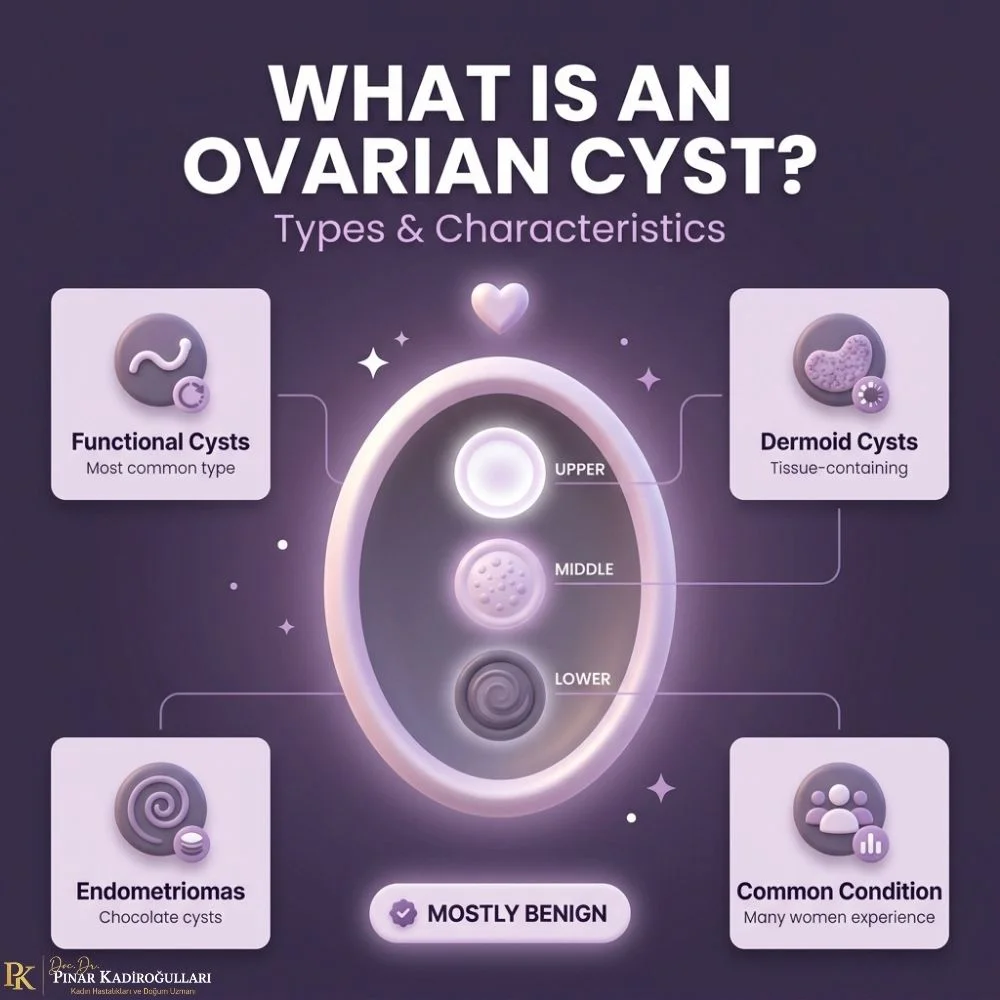
An ovarian cyst is a fluid-filled or semi-solid sac that develops inside or on the surface of the ovaries. Most cysts are benign and resolve on their own. However, some cysts require surgical intervention; in such cases, the surgical approach is determined based on the type of cyst.
Types of Ovarian Cysts
1. Functional Cysts: The most common type of cyst. They are divided into two categories: follicular cysts and corpus luteum cysts. They generally resolve on their own within 2-3 months and most often do not require surgery.
2. Endometrioma (Chocolate Cyst): These are cysts caused by endometriosis on the ovary. They contain old blood. For detailed information, you can visit our Chocolate Cyst Treatment page.
3. Dermoid Cysts (Teratoma): These are congenital cysts. They may contain hair, skin, fatty tissue, and even teeth. They are generally removed surgically.
4. Cystadenoma: These cysts develop from the surface cells of the ovary. They may have serous (water-like) or mucinous (sticky) contents. They can grow to large sizes and require surgery.
5. Polycystic Ovary Syndrome (PCOS): A hormonal condition characterized by multiple small cysts. For details, you can visit our PCOS Treatment page.
6. Malignant (Cancerous) Cysts: These can be an early sign of ovarian cancer. Cysts detected in the postmenopausal period require particularly careful evaluation.
Important Information
The diagnosis and follow-up of ovarian cysts are of critical importance. A detailed evaluation is performed using transvaginal ultrasound, the CA-125 blood test, and MRI when necessary. The type of cyst is the main factor that determines the need for surgery and the chosen surgical method.
In Which Cases Is Ovarian Cyst Surgery Necessary?
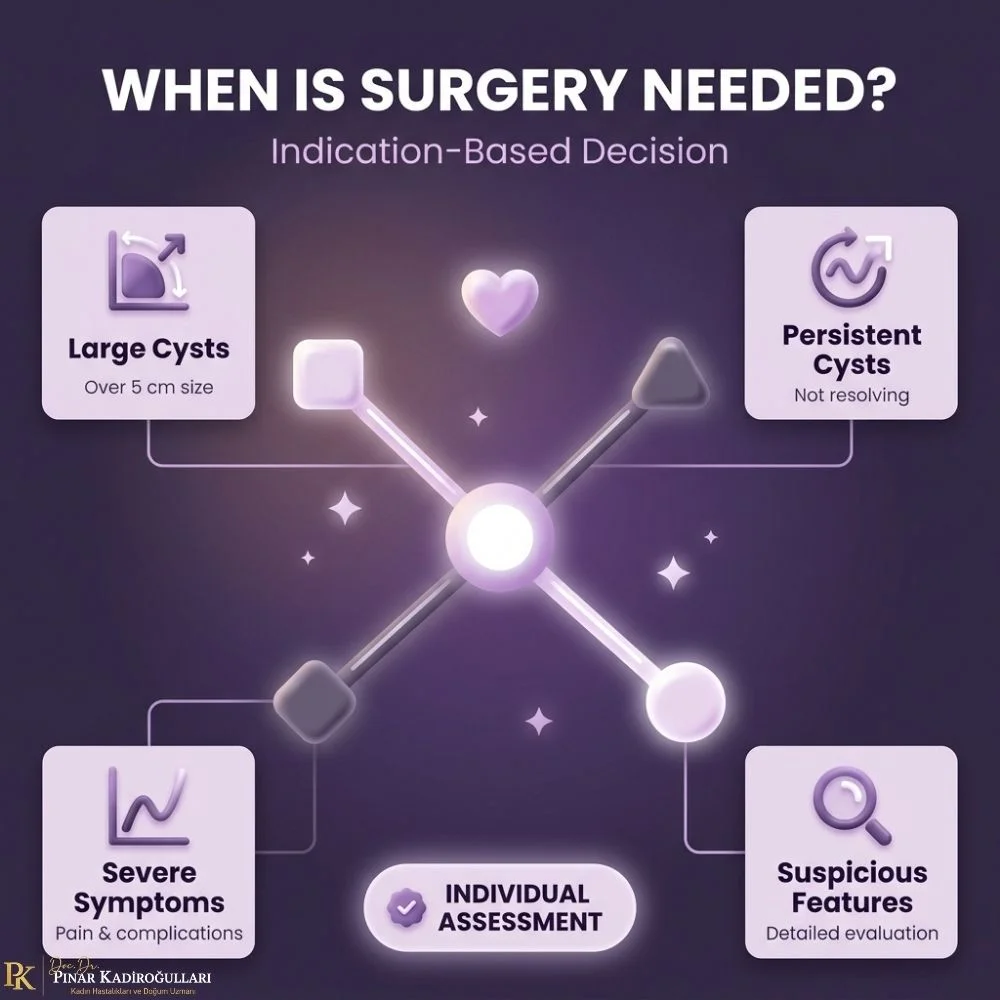
The decision for ovarian cyst surgery is made based on the cyst’s size, type, the patient’s age, and symptoms. While most functional cysts disappear with monitoring, some cysts require surgical treatment.
1. Structural Features of the Cyst
- Cysts larger than 5-6 cm (especially those that do not shrink after 3 months)
- Cysts containing solid components
- Complex cysts (with septations or papillary projections)
- Types that do not resolve on their own, such as dermoid cysts and cystadenomas
- Endometrioma (chocolate cyst) larger than 4 cm
- Imaging on ultrasound that raises a suspicion of malignancy
2. Clinical Symptoms
- Severe pelvic pain or a sensation of pressure
- Menstrual irregularities and heavy bleeding
- Abdominal swelling or a palpable mass
- Frequent urination or constipation (due to pressure on adjacent organs)
- Pain during sexual intercourse (dyspareunia)
- Infertility or recurrent pregnancy loss
3. Conditions Requiring Emergency Surgery
- Ovarian torsion (twisting of the ovary — emergency!)
- Cyst rupture and internal bleeding
- Severe and persistent sudden pelvic pain
- Hemoperitoneum (intra-abdominal bleeding)
4. Risk Factors
- A newly developed cyst in the postmenopausal period
- A family history of ovarian or breast cancer
- BRCA mutation carriership
- Elevated CA-125 levels
Diagnostic Process
The diagnosis of an ovarian cyst is made through a gynecological examination, transvaginal ultrasound, and the CA-125 blood test, and when necessary, an MRI scan. All features of the cyst are evaluated in detail before deciding on surgery.
Ovarian Cyst Surgical Methods
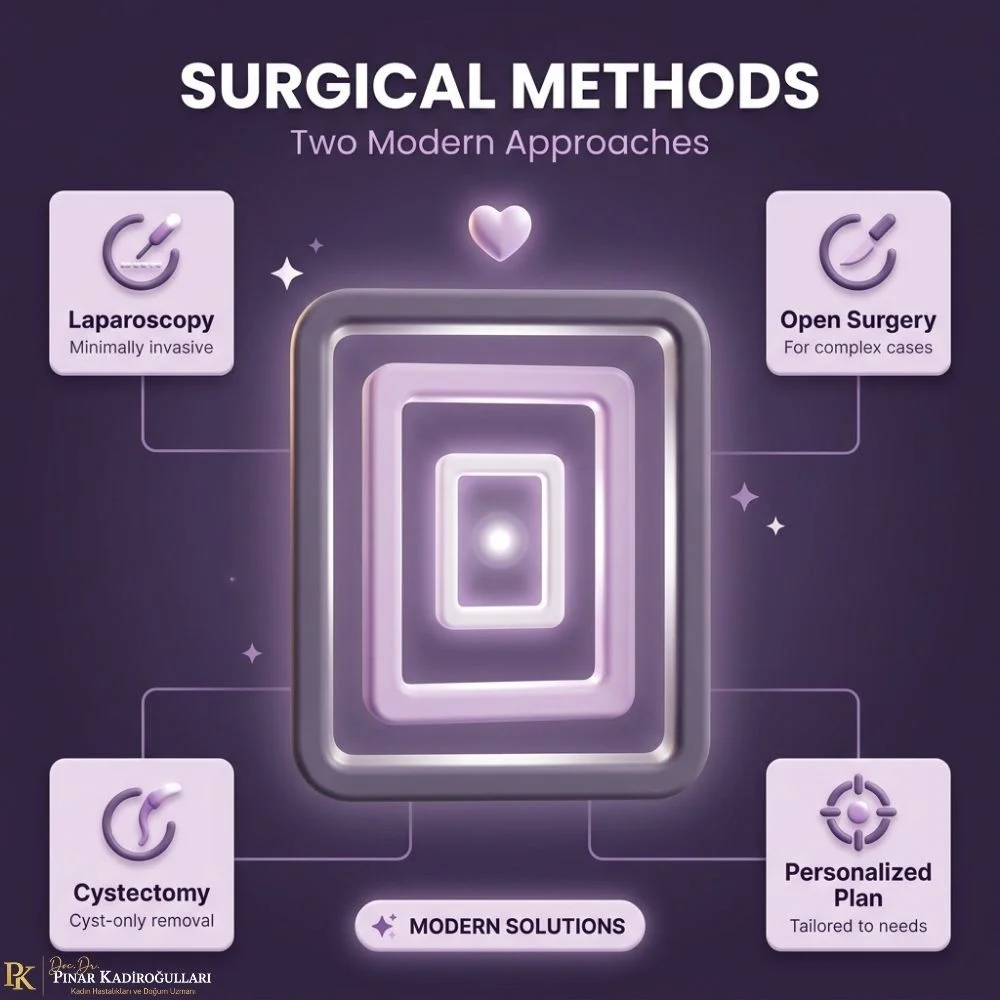
The method of ovarian cyst surgery is determined by considering the cyst’s size, type, suspicion of malignancy, and the patient’s age. In modern gynecological surgery, there are three main approaches: laparoscopic cystectomy, open surgery, and oophorectomy (removal of the ovary).
Method 1 – The Most Preferred
Laparoscopic Cystectomy (Closed Surgery)
Through 3-4 small incisions in the abdomen, only the cyst is removed using a camera and specialized instruments while preserving the ovarian tissue.
- Indications: Benign cysts, chocolate cysts, dermoid cysts, and cystadenomas.
- Duration: 45-90 minutes, performed under general anesthesia.
- Discharge: Same day or the next day, with a return to normal life within 1 week.
- Advantages: Preserves fertility, small incisions, and rapid recovery.
- Limitations: Careful planning is required for very large cysts (>10 cm) or those with suspicion of malignancy.
Method 2 – For Special Cases
Open Cystectomy (Laparotomy)
A traditional method in which the ovarian cyst is removed through a single incision in the abdomen.
- Indications: Very large cysts, suspicion of malignancy, or extensive adhesions.
- Duration: 1-2 hours, performed under general anesthesia.
- Discharge: 3-5 days, with full recovery in 4-6 weeks.
- Advantages: Wider surgical field; suitable for cancer surgery.
- Limitations: Longer recovery period and a visible surgical scar.
Method 3 – For Selected Cases
Oophorectomy (Removal of the Ovary)
An advanced surgical method in which the ovary is partially or completely removed. It is typically performed laparoscopically or through open surgery.
- Indications: Malignancy, postmenopausal age, BRCA mutation, or extensive damage.
- Duration: 1-2 hours, performed under general anesthesia.
- Discharge: 1-2 days if performed laparoscopically; 3-5 days if performed openly.
- Advantages: Cancer prevention and definitive treatment.
- Limitations: If performed unilaterally, the other ovary continues to maintain reproductive function.
Recovery and Fertility After Ovarian Cyst Surgery
The recovery process after ovarian cyst surgery varies significantly depending on the surgical method used. With modern laparoscopic techniques, patients return to their daily lives much more quickly. After cystectomy, where the ovarian tissue is preserved, the chance of pregnancy remains very high.
Recovery Timelines (By Method)
- Laparoscopic cystectomy: Discharge on the same day or within 1 day, light work after 1 week, and full activity within 2-3 weeks.
- Open cystectomy: Discharge in 3-5 days, with full recovery in 4-6 weeks.
- Oophorectomy: Recovery varies depending on the method, ranging from 2 to 6 weeks.
Postoperative Considerations
- First 24-48 hours: Mild bleeding and abdominal pain are normal.
- Heavy lifting is prohibited during the first week after surgery.
- Sexual intercourse: May be resumed after 4-6 weeks (following a follow-up examination).
- Regular walking improves blood circulation.
- The pathology results must be carefully followed up.
Fertility After Ovarian Cyst Surgery
- After cystectomy: Since the ovarian tissue is preserved, fertility is fully maintained.
- Waiting period for pregnancy: Pregnancy may be attempted after 2-3 months.
- The chance of pregnancy increases significantly after surgery for chocolate cysts.
- After unilateral oophorectomy, the other ovary continues to maintain its function.
- Surgical menopause begins after bilateral oophorectomy.
⚠️ When to Consult a Physician
- Fever above 38°C or chills
- Severe pain that does not respond to painkillers
- Excessive or clotted vaginal bleeding
- Redness, discharge, or foul odor at the wound site
- Swelling or pain in the leg (a sign of thrombosis)
- Sudden shortness of breath
Important Reminder
Ovarian cyst surgery is a modern surgical method that preserves fertility. The vast majority of patients achieve a successful pregnancy after surgery. You can also visit our Infertility Treatment page.

Frequently Asked Questions
Is ovarian cyst surgery always necessary?
No, not all ovarian cysts require surgery. Most functional cysts resolve on their own within 2-3 months. The decision for surgery is made based on the cyst’s size (over 5-6 cm), type, suspicion of malignancy, and symptoms. Asymptomatic small cysts are monitored through regular ultrasound follow-ups. Surgery is only recommended when necessary.
Can I become pregnant after ovarian cyst surgery?
Yes, fertility is fully preserved after laparoscopic cystectomy. Since only the cyst is removed while the ovarian tissue is preserved, the chance of pregnancy is not significantly affected. After the removal of a chocolate cyst or an endometrioma, the chance of pregnancy increases noticeably. Even after a unilateral oophorectomy (removal of one ovary), pregnancy is still possible since the other ovary continues to function.
How long does ovarian cyst surgery take?
The duration of ovarian cyst surgery varies depending on the type of procedure performed. Laparoscopic cystectomy takes 45-90 minutes, open cystectomy takes 1-2 hours, and oophorectomy (removal of the ovary) takes 1-2 hours. The duration may extend in the case of very large or complex cysts. This duration does not include pre-anesthesia preparation and post-anesthesia recovery.
Can ovarian cysts recur?
The risk of ovarian cyst recurrence depends on the type of cyst. The recurrence rate for endometriomas (chocolate cysts) is between 15-30%. Cysts such as dermoid cysts and cystadenomas generally do not recur. Functional cysts may occur cyclically on a monthly basis during the reproductive years. Regular gynecological check-ups allow for the early detection of new cyst development. After menopause, the formation of new cysts is not expected.
Will my menstrual periods change after ovarian cyst surgery?
Menstrual regularity is generally preserved after cystectomy. Since the ovarian tissue is preserved, the hormonal balance is maintained. Some menstrual irregularity may occur during the first 1-2 months, which is considered normal. After a unilateral oophorectomy, the other ovary continues to function, and menstrual periods remain regular. A bilateral oophorectomy, however, induces surgical menopause; in this case, menstruation ceases, and hormone replacement therapy may be planned.
Our Treatments



Blog Yazılarımız
References
The medical content on this page has been prepared based on the current clinical guidelines and scientific publications of international and national authoritative organizations. A valuable feature of this page is the inclusion of academic articles by Assoc. Prof. Dr. Pınar Kadiroğulları on endometrioma and ovarian cyst surgery as direct references.
Management of Suspected Ovarian Masses in Premenopausal Women (Green-top Guideline No. 62)
Authors: Royal College of Obstetricians and Gynaecologists (RCOG) & British Society for Gynaecological Endoscopy (BSGE) | Source Type: Green-top Clinical Guideline / PDF
ESHRE Endometriosis Clinical Practice Guideline: Endometrioma Surgery and Fertility
Author: European Society of Human Reproduction and Embryology (ESHRE) | Publication: Human Reproduction Open 2022 | Source Type: International Clinical Practice Guideline (Full Text)
ACOG Clinical Guideline: Diagnosis and Management of Adnexal Masses
Author: American College of Obstetricians and Gynecologists (ACOG) | Source Type: Clinical Guideline / Committee Opinion
Atypical Endometrioma Associated with a High Recurrence Rate: A Study of 2,681 Patients
Study: Retrospective analysis of 2,681 patients with endometriomas | Source Type: Comprehensive Peer-Reviewed Clinical Study (PubMed PMC, Full Text)
The Effects of Laparoscopic Cystectomy on Ovarian Reserve in Endometrioma and Dermoid Cysts
Authors: Karadağ C, Demircan S, Turgut A, Çalışkan E (Turkish academics) | Publication: Turkish Journal of Obstetrics and Gynecology (TJOD Journal) 2020 | Source Type: Turkish Peer-Reviewed Clinical Study (PubMed PMC)
Atypical Endometriosis: A Comprehensive Systematic Review of Pathological Patterns and Diagnostic Challenges
Publication: Biomedicines 2024 | Source Type: Peer-Reviewed Systematic Review (PubMed PMC, Full Text)
SOGC Clinical Practice Guideline: Diagnosis and Management of Adnexal Masses
Author: Society of Obstetricians and Gynaecologists of Canada (SOGC) | Publication: JOGC | Source Type: Clinical Practice Guideline
⭐ Academic Publications by Assoc. Prof. Dr. Pınar Kadiroğulları on Ovarian Cysts
Scientific publications authored by the doctor in the fields of endometrioma, dermoid cysts, and ovarian reserve
Dermoid Tumor Coexisting with Endometrioma in a Single Ovary: A Case Presented as Atypical Endometrioma
Authors: Kıyak H, Kadiroğulları P, Karacan T, Seçkin KD, Karataş S | Publication: CRSLS – Journal of the Society of Laparoendoscopic Surgeons, April 2019 | Source Type: Peer-Reviewed Case Report
📍 This publication is a case report directly focused on ovarian cysts — endometrioma and dermoid cyst. It precisely matches the topic of this page.
The Relationship Between HbA1c Levels and Ovarian Reserve: A Clinical Study in Type 1 Diabetes Patients
Authors: Kadiroğulları P, Demir E, Bahat PY, Kıyak H, Seçkin KD | Publication: Gynecological Endocrinology 2020;36(5):426-430 | Source Type: Peer-Reviewed Scientific Article (PubMed)
Modified Extraperitoneal Uterosacral Ligament Suspension: A 4-Clamp Technique After Vaginal Hysterectomy
Authors: Kadiroğulları P, Seçkin KD | Publication: Journal of Investigative Surgery 2019 | Source Type: Peer-Reviewed Clinical Research (PubMed)
Important Note
The information on this page is intended for general informational purposes and does not replace individual medical advice. For personal questions regarding the diagnosis of ovarian cysts, the planning of laparoscopic cystectomy, and your health, you should always consult your specialist gynecologist. The content of this page has been prepared by Assoc. Prof. Dr. Pınar Kadiroğulları in light of clinical experience and current scientific literature.
“Cutting-Edge Technology & Expert Experience”